Types
Humidifier vs vaporizer
A vaporizer is a warm mist humidifier. The word is older and it survives mostly on pharmacy shelves, which is why people assume it describes a different machine.
By Scooter M. · Published · Updated
We earn a commission if you buy through the links on this page, at no extra cost to you. It does not change what we recommend or the order the picks appear in. Full disclosure. Prices checked October 16, 2026.
| # | Product | Best for | Gal/day | Price |
|---|---|---|---|---|
| 1 | 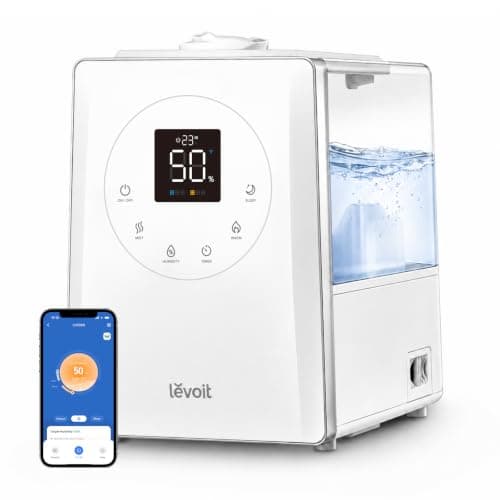 Levoit LV600S HybridTop pickWarm and cool mist from a 6-liter tank, and the only Levoit in this set that publishes a maximum output. On warm mist it genuinely covers a floor of a house. | The one unit here that publishes an output figure | 3.5published · 1,033 sq ft | |
| 2 | 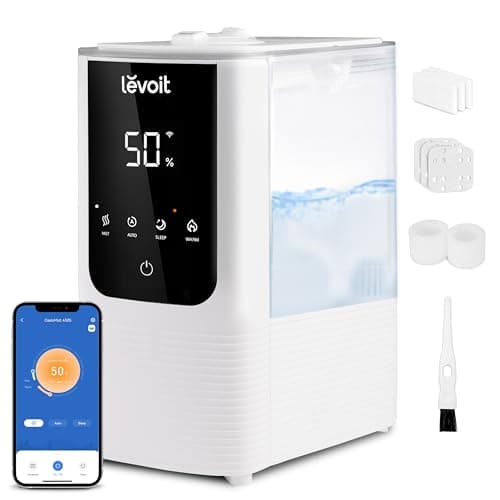 Levoit OasisMist 450SWarm and cool mist in a 4.5-liter body with a published sub-26 dB cool setting. Small, quiet, and no filter subscription. | A quiet bedside unit with a heater | 0.63implied · 188 sq ft | |
| 3 | 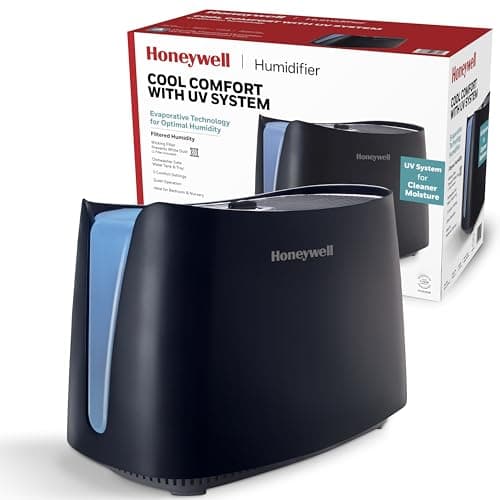 Honeywell HCM350 Germ Free Cool MoistureA break-resistant, dishwasher-safe tank and a wide opening. It is the only unit here designed so the hardest part of ownership is easy. | Cleaning, without qualification | 1.0implied · 296 sq ft |
In American usage, a vaporizer is a humidifier that heats water to make steam. It is the same category of appliance as a warm-mist humidifier, and the two words are largely interchangeable. The distinction survives because vaporizers are sold in pharmacies alongside cold remedies while humidifiers are sold in appliance aisles, which gives the impression they are different devices. A garment or facial steamer is a different thing again - see humidifier vs steamer.
We earn a commission if you buy through the links on this page, at no extra cost to you. It does not change what we recommend or the order the picks appear in. Full disclosure. Prices checked October 16, 2026.
| # | Product | Best for | Gal/day | Price |
|---|---|---|---|---|
| 1 | Levoit LV600S HybridTop pickWarm and cool mist from a 6-liter tank, and the only Levoit in this set that publishes a maximum output. On warm mist it genuinely covers a floor of a house. | The one unit here that publishes an output figure | 3.5published · 1,033 sq ft | |
| 2 | Levoit OasisMist 450SWarm and cool mist in a 4.5-liter body with a published sub-26 dB cool setting. Small, quiet, and no filter subscription. | A quiet bedside unit with a heater | 0.63implied · 188 sq ft | |
| 3 | Honeywell HCM350 Germ Free Cool MoistureA break-resistant, dishwasher-safe tank and a wide opening. It is the only unit here designed so the hardest part of ownership is easy. | Cleaning, without qualification | 1.0implied · 296 sq ft |
Where the words came apart
| Term | What it usually means | Where you see it |
|---|---|---|
| Vaporizer | A warm mist unit that boils water | Pharmacies, cold-and-flu aisles, older packaging |
| Warm mist humidifier | The same thing | Appliance retailers |
| Cool mist humidifier | Ultrasonic or evaporative - no heat | Everywhere |
| Humidifier | The whole category, warm and cool | Everywhere |
What actually differs, and what does not
Since a vaporizer is a warm-mist humidifier, the comparison that matters is warm against cool, which we cover in full on warm mist vs cool mist. The headline points:
- Electricity. Boiling water is expensive relative to not boiling it. The Levoit warm-mist units in our set are rated at 280 W against 17 to 30 W for cool-mist ones, which is roughly $75 against $7 for a season of overnight running at the US average rate.
- No white dust. Minerals stay in the boiling chamber rather than going into the air, so tap water is fine for air quality - and the chamber scales up and needs descaling.
- A hot component. This is the substantive safety difference. A vaporizer contains hot water and a heated element, at floor level, in a room often used by a child.
- Slight room warming, rather than the slight cooling a cool-mist unit produces by evaporation.
The medicated cup
We can describe how it works and we are not going to tell you whether to use it. The cup is deliberately outside the water: additives go in a separate well and are vaporized by the unit's heat, rather than being boiled in the tank, which would leave residue in the water path. Putting anything other than water directly into a humidifier tank is outside almost every manufacturer's instructions and will typically void the warranty.
Which to buy
Ignore the word on the box and choose on the same three grounds as any other purchase: the output it publishes against the size of your room, the electricity it will draw at the setting you will actually use, and how easy it is to clean, because the EPA's every-third-day instruction applies to a vaporizer exactly as it does to anything else with a tank.
If there are small children in the house and no clinical reason pointing the other way, cool mist removes the hot-water hazard entirely, and the modern hybrids give you a warm setting for the nights you want it. That is the practical version of this comparison.
The picks, in full
Top pick · The one unit here that publishes an output figure
Levoit LV600S Hybrid
Warm and cool mist from a 6-liter tank, and the only Levoit in this set that publishes a maximum output. On warm mist it genuinely covers a floor of a house.
This is the only unit in the portable group whose maker publishes an output rate, and publishing it is worth crediting. 550 mL an hour is 13.2 liters a day, which is 3.49 gallons a day, which covers roughly 1,030 square feet at our derived rate. That is more than its own 753 sq ft claim, so for once the box is conservative.
The catch is the setting. 3.49 gallons a day on maximum warm mist empties a 6-liter tank in about eleven hours and draws 280 watts while it does it. On the lowest setting the same machine moves 0.76 gallons a day and covers about 224 square feet. One box, a four-and-a-half-fold range, and only the two ends published.
280 watts is the number to think about if you plan to run warm mist all winter. Boiling water is not free, and this is the page where that becomes a real line on a bill rather than a footnote.
What works
- Publishes an actual output rate, which almost nobody in this category does
- Warm mist is genuinely useful in a cold room and slightly reduces microbial growth in the tank
- 6 liters with a 753 sq ft claim that its own maximum output can actually support
What does not
- 280 W rated: warm mist all season is a real electricity cost, not a rounding error
- Maximum output empties the tank in about eleven hours
- The gap between lowest and highest setting is roughly 4.5x, and only the two extremes are published
Skip this ifyou want to run it flat out overnight and forget it. At the published maximum it needs refilling before morning.
The arithmetic
- Published output (lowest mist)
- 3.5 gal/day
- Covers, at 296 sq ft per gal/day
- 1,033 sq ft
- Maker’s coverage claim
- 753 sq ft
- Output that claim would need
- 2.5 gal/day
Output as the manufacturer publishes it. Coverage rate derived from Aprilaire’s own published capacity-and-coverage pairs.
Published specification
- Tank
- 1.58 gal / 6 LSource
- Output/day
- 550 mL/h max warm mistLevoit publishes this as an hourly rate. Over 24 hours that is 13.2 L, or 3.49 gallons per day.Source
- Coverage
- 430-753 sq ft / 40-70 m2Source
- Run time
- Up to 50 hOn the lowest mist settingSource
- Power
- 280 WThe heater dominates. Cool mist alone draws far less.Source
- Filter
- Water filter sponge, 2 suppliedA sponge, not a wick. No scheduled replacement interval is published.Source
- Cleaning
- Descaling pads sold separatelySource
#ad · how this is funded · price as of October 16, 2026
Pick 2 · A quiet bedside unit with a heater
Levoit OasisMist 450S
Warm and cool mist in a 4.5-liter body with a published sub-26 dB cool setting. Small, quiet, and no filter subscription.
Under 26 dB on low cool mist is the kind of figure that decides whether a machine stays in a bedroom, and Levoit publishes both ends of the range rather than just the flattering one. The 41 dB high warm figure is honest and worth knowing before you buy.
0.64 gallons a day implied on low puts this in the same real-world class as the Classic 300S despite a smaller tank: same daily water, fewer hours between refills. If the 300S is too tall for a nightstand, this is the same machine in a shorter body with a heater added.
The 280 W rating is the heater, as it is on the LV600S. On cool mist the draw is a fraction of that. If you never use warm mist you are not paying for it, but you did buy it.
What works
- Publishes noise at both extremes rather than only the quiet one
- Warm and cool in a body small enough for a nightstand
- No wick filter to buy on a schedule
What does not
- 4.5 L means more refills than the 6 L and 10 L units for the same daily output
- 280 W rated with the heater on
- The 430 sq ft claim is about 2.3x what its published tank and run time imply
Skip this ifyou want the biggest room this brand covers. The 6-liter LV600S publishes an output figure and a larger claim for similar money.
The arithmetic
- Implied output (low mist)
- 0.63 gal/day
- Covers, at 296 sq ft per gal/day
- 188 sq ft
- Maker’s coverage claim
- 430 sq ft
- Output that claim would need
- 1.5 gal/day
Output derived as tank capacity divided by published run time, times 24. Coverage rate derived from Aprilaire’s own published capacity-and-coverage pairs.
Published specification
- Tank
- 1.19 gal / 4.5 LSource
- Output/day
- not published
- Coverage
- 215-430 sq ft / 20-40 m2Published tank and run time imply roughly 188 sq ft at our derived rateSource
- Run time
- Up to 45 hOn the low mist settingSource
- Power
- 280 WRated with the warm-mist heater engagedSource
- Noise
- Under 26 dB low cool, under 41 dB high warmSource
- Filter
- Water filter sponge, 2 suppliedSource
- Cleaning
- Top-fillSource
$89.99 · 16% off
#ad · how this is funded · price as of October 16, 2026
Pick 3 · Cleaning, without qualification
Honeywell HCM350 Germ Free Cool Moisture
A break-resistant, dishwasher-safe tank and a wide opening. It is the only unit here designed so the hardest part of ownership is easy.
One gallon over 24 hours is one gallon a day, which at our derived rate is about 296 square feet. Honeywell says medium room. Those two statements agree, which is a low bar that most of this category fails to clear.
The reason to buy it is the tank. Dishwasher-safe and break-resistant, with an opening wide enough to actually reach inside, against an EPA instruction to clean every third day. A humidifier you will genuinely clean twice a week beats a larger one you will clean twice a winter, and this is the only unit here whose maker treats that as a design requirement rather than a footnote.
There is one inconsistency worth naming. The specification table on Honeywell's own page says a 1 gallon tank; the feature copy a few hundred pixels above it says 1.1 gallons. It is a small discrepancy and it is on the maker's own page, which is a fair illustration of why we quote the table and say which one we took.
What works
- Dishwasher-safe, break-resistant tank with a wide opening, which is the whole ballgame for maintenance
- The wicking filter captures minerals, so no white dust regardless of your water
- The published tank and run time are consistent with the room size claimed
What does not
- HAC504 wicks are a recurring cost with no interval published on the product page
- One gallon a day is a bedroom, not a floor of a house
- The maker's own page states two different tank capacities
Skip this ifyou need to humidify an open-plan living space. This is a one-room machine and its own figures say so.
The arithmetic
- Implied output (continuous)
- 1.0 gal/day
- Covers, at 296 sq ft per gal/day
- 296 sq ft
Output derived as tank capacity divided by published run time, times 24. Coverage rate derived from Aprilaire’s own published capacity-and-coverage pairs.
Published specification
- Tank
- 1 galHoneywell's own specification table says 1 gallon; the marketing copy on the same page says 1.1. We quote the table.Source
- Output/day
- not publishedTank and run time only
- Coverage
- Medium roomHoneywell publishes a size class rather than a number. Its published tank and run time imply about 1 gallon per day, or roughly 296 sq ft at our derived rate.Source
- Run time
- Up to 24 hSource
- Power
- not published
- Filter
- HAC504 Filter AOne included. Honeywell states its own filters should be used.Source
- Cleaning
- Dishwasher safe, break resistant tank, wide openingHoneywell's own wording. It also states the wicking filter removes impurities from the water, reducing white dust.Source
#ad · how this is funded · price as of October 16, 2026
Questions people actually ask
Is a vaporizer the same as a humidifier?
Effectively yes. A vaporizer is a humidifier that heats water to make steam - what the appliance industry calls a warm mist humidifier. The separate word survives mainly because vaporizers are sold in pharmacies rather than appliance aisles.
What is the difference between a vaporizer and a cool mist humidifier?
Heat. A vaporizer boils water, which costs about ten times as much in electricity - the Levoit warm-mist units in our set are rated at 280 W against 17 to 30 W for cool mist - but leaves minerals in the boiling chamber so there is no white dust. It also contains hot water, which is a burn hazard at floor level.
Can you put medicine in a humidifier?
Not in the water tank. Vaporizers often have a separate medicated-additive cup outside the water path, designed for exactly this; putting additives directly in the tank is outside most manufacturers' instructions and typically voids the warranty. Whether to use an additive at all is a question for a pharmacist or clinician.
Is a vaporizer safe for a child's room?
It contains hot water and a heated element at floor level, which is the standard reason cool mist is recommended around small children. Anything beyond the physical hazard is a clinical judgment and we are not qualified to make it.
Sources
Every figure on this page came from one of the documents below, read on the date shown. We do not cite other review sites, forum posts or video reviews as sources of fact.
- Levoit LV600S - manufacturer spec page (retrieved September 1, 2026)
- Levoit OasisMist 450S - manufacturer spec page (retrieved September 1, 2026)
- Honeywell HCM350 - manufacturer spec page (retrieved September 1, 2026)
- US Energy Information Administration - Electric Power Monthly, Table 5.3: average residential price 18.34 cents per kilowatthour, United States, June 2026
- US Environmental Protection Agency - Use and Care of Home Humidifiers (relative humidity ceiling, three-day cleaning interval, low-mineral water, microorganism warning)
Read next

Warm or cool
Warm mist vs cool mist
Warm mist against cool mist, with the electricity arithmetic that most comparisons leave out entirely.
Top pick: Levoit LV600S Hybrid · 3.5 gal/day
#ad · how this is funded · price as of October 16, 2026
Running cost
How much a humidifier costs to run
Season electricity costs for every unit in our set, computed at the EIA's published US average residential rate.
Top pick: Levoit Classic 160 · 0.63 gal/day
$39.99 · 26% off
#ad · how this is funded · price as of October 16, 2026
Best for bedrooms
Best humidifiers for bedrooms
Bedroom picks ranked on published noise figures and maintenance design, because capacity is not the binding constraint at this size.
Top pick: Levoit OasisMist 450S · 0.63 gal/day
$89.99 · 16% off
#ad · how this is funded · price as of October 16, 2026
Found a number that is wrong? Tell us and we will fix it and say so. How we pick shows every formula used on this page.