Cost
Wick vs Water Panel
Two pieces of treated paper doing the same job, with replacement intervals an order of magnitude apart. The difference is not the material, it is what happens to the water that does not evaporate.
By Scooter M. · Published · Updated
We earn a commission if you buy through the links on this page, at no extra cost to you. It does not change what we recommend or the order the picks appear in. Full disclosure. Prices checked October 17, 2026.
| # | Product | Best for | Gal/day | Price |
|---|---|---|---|---|
| 1 | 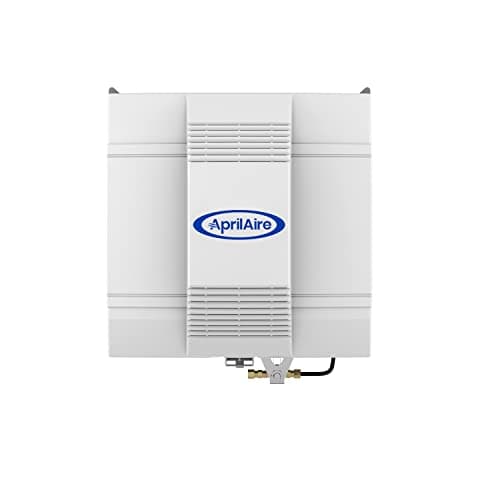 Aprilaire Model 700Top pickEighteen gallons a day against a stated 5,300 sq ft, cited to AHRI Guideline F. It is ducted, it needs installing, and it is the only sizing claim here with a standard behind it. | An actual whole house, sized against a standard | 18.0published · 5,328 sq ft | |
| 2 | 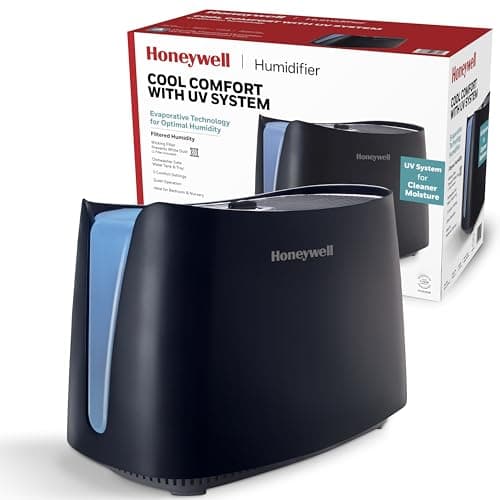 Honeywell HCM350 Germ Free Cool MoistureA break-resistant, dishwasher-safe tank and a wide opening. It is the only unit here designed so the hardest part of ownership is easy. | Cleaning, without qualification | 1.0implied · 296 sq ft | |
| 3 | 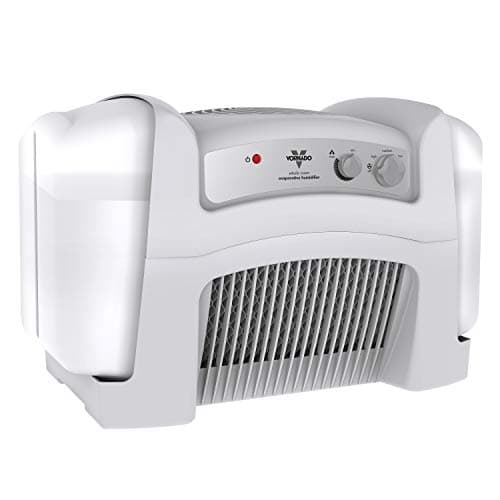 Vornado Evap40Vornado publishes an output figure and a coverage figure, and the two agree. Four gallons a day covers about 1,180 sq ft at our derived rate against a 1,000 sq ft claim. | The only coverage claim here the arithmetic supports | 4.0published · 1,184 sq ft | |
| 4 | 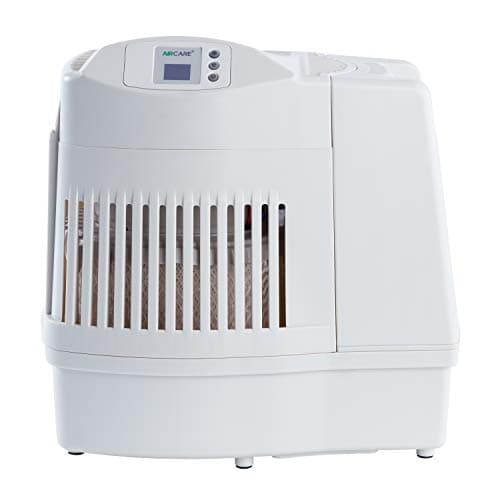 AIRCARE MA0800 Mini-ConsoleA 2.5-gallon evaporative console with three fan speeds, an adjustable humidistat and a MAF2 SuperWick. Its 2,600 sq ft claim is far beyond what its own tank and run time imply, so size it as a large room rather than a floor. | A plug-in console with its own humidistat | 1.7implied · 493 sq ft |

A humidifier wick and a whole-house Water Panel are the same idea: a treated, high-surface-area medium that holds water for air to evaporate off. They are made of broadly similar stuff. And the published replacement intervals differ by roughly an order of magnitude. That gap is worth understanding, because it explains most of the cost-of-ownership difference between the two kinds of machine.
We earn a commission if you buy through the links on this page, at no extra cost to you. It does not change what we recommend or the order the picks appear in. Full disclosure. Prices checked October 17, 2026.
| # | Product | Best for | Gal/day | Price |
|---|---|---|---|---|
| 1 | Aprilaire Model 700Top pickEighteen gallons a day against a stated 5,300 sq ft, cited to AHRI Guideline F. It is ducted, it needs installing, and it is the only sizing claim here with a standard behind it. | An actual whole house, sized against a standard | 18.0published · 5,328 sq ft | |
| 2 | Honeywell HCM350 Germ Free Cool MoistureA break-resistant, dishwasher-safe tank and a wide opening. It is the only unit here designed so the hardest part of ownership is easy. | Cleaning, without qualification | 1.0implied · 296 sq ft | |
| 3 | Vornado Evap40Vornado publishes an output figure and a coverage figure, and the two agree. Four gallons a day covers about 1,180 sq ft at our derived rate against a 1,000 sq ft claim. | The only coverage claim here the arithmetic supports | 4.0published · 1,184 sq ft | |
| 4 | AIRCARE MA0800 Mini-ConsoleA 2.5-gallon evaporative console with three fan speeds, an adjustable humidistat and a MAF2 SuperWick. Its 2,600 sq ft claim is far beyond what its own tank and run time imply, so size it as a large room rather than a floor. | A plug-in console with its own humidistat | 1.7implied · 493 sq ft |
The published intervals
| Consumable | Unit | Stated interval | Per 182-day season |
|---|---|---|---|
| Model 35 Water Panel | Aprilaire 700, ducted | Annually (maintenance page); the product page says once or twice per season | 1-2 |
| Antimicrobial filter | Canopy, portable | Every 45 days | 4.0 |
| HAC504 Filter A | Honeywell HCM350, portable | not published | unknown |
| MD1 wicks x2 | Vornado Evap40, portable | not published | unknown |
| MAF2 SuperWick | AIRCARE MA0800, portable | not published | unknown |
Why the difference is drainage
A wick in a portable humidifier sits in a tray of standing water. Water is drawn up it, evaporates, and the dissolved mineral that came with it stays behind in the medium. Every gallon that passes through leaves its hardness in the wick. Nothing removes it. The wick fills up with mineral until it can no longer hold or release water, and then you replace it.
A ducted Water Panel does not sit in standing water. Water is fed across it continuously and the excess goes down a drain, taking dissolved mineral with it out of the building. Aprilaire describes exactly this: a built-in drain flushes mineral build-up so water does not accumulate inside the unit. The panel is a surface for evaporation, not a mineral trap.
The cost of the drain
It is water. A drained humidifier deliberately sends part of its supply down the drain to carry mineral away. That is a genuine ongoing cost and it is a genuine environmental cost, and it is the reason Aprilaire's water-saving Model 400 exists as a separate product - it captures excess water in a reservoir rather than draining it, which is Aprilaire's own stated design difference.
Notice the trade that implies: the water-saving model does not drain as freely, so it retains more mineral, and it uses a different Water Panel. There is no free lunch in this mechanism, only a choice about where the mineral goes.
What it means when you are shopping
| Portable wick | Ducted Water Panel | |
|---|---|---|
| Where mineral goes | Into the medium, permanently | Out of the building, down the drain |
| Replacement frequency | Weeks to a couple of months | Once or twice a heating season |
| Standing water | Yes - hence the cleaning schedule | None |
| Water wasted | None | Yes, by design |
| Effect of hard water | Shortens wick life directly | Handled by drainage |
| Cost visibility | Usually unpublished | Aprilaire publishes its schedule |
The rule this gives you
If you have hard water and you are choosing between evaporative portables, wick life is the running cost, and the maker who will not tell you the interval is asking you to buy blind. If you have hard water and you are choosing between a portable and a ducted unit, drainage is a bigger advantage than the specification sheets make it look - it is not just a longer consumable interval, it is the removal of the entire standing-water maintenance regime.
And if you are on soft water, most of this matters less, and a filter-free ultrasonic unit sidesteps the consumable question entirely. That trade is on filter-free vs filtered.
The picks, in full
Top pick · An actual whole house, sized against a standard
Aprilaire Model 700
Eighteen gallons a day against a stated 5,300 sq ft, cited to AHRI Guideline F. It is ducted, it needs installing, and it is the only sizing claim here with a standard behind it.
This is the reference point for the whole site. Aprilaire is the only maker in our set that publishes a capacity in gallons per day and a coverage in square feet together, and cites the residential sizing standard as the basis for pairing them. Three of its models do it consistently: 12 gal/day to 3,600 sq ft, 17 to 5,000, and 18 to 5,300. Those three pairs are where our 296 square feet per gallon per day comes from.
Everything else follows from the fact that it drains. There is no reservoir, so there is no standing water, so the pink film and the mold that dominate portable-humidifier ownership simply do not arise. The Water Panel goes once or twice a heating season instead of a wick every 30 to 60 days, which changes the recurring cost by an order of magnitude.
The honest counterweight is that this is not a purchase, it is a project. It mounts in ductwork, it needs a water line and a drain, it needs a humidistat and an outdoor sensor, and unless you are comfortable cutting into a plenum it needs a contractor. Our whole-house cost page works through the break-even against running several portables.
What works
- The only sizing claim in this set with a published standard behind it
- No reservoir, so no standing water and none of the maintenance that follows from it
- Water Panel changed once or twice a season instead of a wick every month or two
What does not
- Requires ducted forced-air heating, a water supply, a drain and, realistically, an installer
- Installed cost is a different order of magnitude from any portable here
- Wastes water: the drain design that keeps it clean also sends water to waste
Skip this ifyou rent, or you heat with anything other than a ducted forced-air system. Neither is a fixable objection.
The arithmetic
- Published output (continuous)
- 18.0 gal/day
- Covers, at 296 sq ft per gal/day
- 5,328 sq ft
- Maker’s coverage claim
- 5,300 sq ft
- Output that claim would need
- 17.9 gal/day
Output as the manufacturer publishes it. Coverage rate derived from Aprilaire’s own published capacity-and-coverage pairs.
Published specification
- Tank
- not publishedThere is no tank. It is plumbed to the water supply and drains to waste.
- Output/day
- 18 gal/daySource
- Coverage
- Up to 5,300 sq ftAprilaire states this for tightly constructed homes and cites AHRI Guideline FSource
- Power
- 24 VAC via the supplied transformerSource
- Filter
- Model 35 Water PanelAprilaire's maintenance page puts this on an annual schedule, plus an annual distribution-tray inspection. Its product page says once or twice per heating season; the two documents differ and we take the more specific one. Either way it is by far the longest interval of any unit here.Source
- Cleaning
- Built-in drain flushes mineral build-upWater does not stand inside the unit, which removes the standing-water problem entirelySource
#ad · how this is funded · price as of October 17, 2026
Pick 2 · Cleaning, without qualification
Honeywell HCM350 Germ Free Cool Moisture
A break-resistant, dishwasher-safe tank and a wide opening. It is the only unit here designed so the hardest part of ownership is easy.
One gallon over 24 hours is one gallon a day, which at our derived rate is about 296 square feet. Honeywell says medium room. Those two statements agree, which is a low bar that most of this category fails to clear.
The reason to buy it is the tank. Dishwasher-safe and break-resistant, with an opening wide enough to actually reach inside, against an EPA instruction to clean every third day. A humidifier you will genuinely clean twice a week beats a larger one you will clean twice a winter, and this is the only unit here whose maker treats that as a design requirement rather than a footnote.
There is one inconsistency worth naming. The specification table on Honeywell's own page says a 1 gallon tank; the feature copy a few hundred pixels above it says 1.1 gallons. It is a small discrepancy and it is on the maker's own page, which is a fair illustration of why we quote the table and say which one we took.
What works
- Dishwasher-safe, break-resistant tank with a wide opening, which is the whole ballgame for maintenance
- The wicking filter captures minerals, so no white dust regardless of your water
- The published tank and run time are consistent with the room size claimed
What does not
- HAC504 wicks are a recurring cost with no interval published on the product page
- One gallon a day is a bedroom, not a floor of a house
- The maker's own page states two different tank capacities
Skip this ifyou need to humidify an open-plan living space. This is a one-room machine and its own figures say so.
The arithmetic
- Implied output (continuous)
- 1.0 gal/day
- Covers, at 296 sq ft per gal/day
- 296 sq ft
Output derived as tank capacity divided by published run time, times 24. Coverage rate derived from Aprilaire’s own published capacity-and-coverage pairs.
Published specification
- Tank
- 1 galHoneywell's own specification table says 1 gallon; the marketing copy on the same page says 1.1. We quote the table.Source
- Output/day
- not publishedTank and run time only
- Coverage
- Medium roomHoneywell publishes a size class rather than a number. Its published tank and run time imply about 1 gallon per day, or roughly 296 sq ft at our derived rate.Source
- Run time
- Up to 24 hSource
- Power
- not published
- Filter
- HAC504 Filter AOne included. Honeywell states its own filters should be used.Source
- Cleaning
- Dishwasher safe, break resistant tank, wide openingHoneywell's own wording. It also states the wicking filter removes impurities from the water, reducing white dust.Source
#ad · how this is funded · price as of October 17, 2026
Pick 3 · The only coverage claim here the arithmetic supports
Vornado Evap40
Vornado publishes an output figure and a coverage figure, and the two agree. Four gallons a day covers about 1,180 sq ft at our derived rate against a 1,000 sq ft claim.
Run the check that fails everywhere else on this page and it passes here. Four gallons a day at 296 square feet per gallon per day is about 1,180 square feet of coverage, against a claim of 1,000. Vornado left itself margin instead of taking it.
It passes because it is evaporative. A wick and a fan can only put as much water into the air as the air will accept, which is why an evaporative unit self-limits near 50% relative humidity and why it cannot produce white dust: the minerals stay in the wick. The EPA's guidance to use low-mineral water exists mainly because ultrasonic and impeller units disperse what is dissolved in the tank, and this design does not.
The cost of that is the wick. Two of them, on a schedule Vornado does not publish, which is the recurring bill an ultrasonic unit does not have. Whether that trade is worth it is arithmetic, and it is worked through in full on our filter-cost page.
What works
- Publishes an output figure, and the coverage claim survives being checked against it
- Evaporative, so it cannot produce white dust and self-limits near a safe humidity
- Five-year warranty, the longest published here
What does not
- Two wicks to replace on an interval Vornado does not publish
- A fan moving air across a wet wick is audible, and no dB figure is published
- No rated wattage published
Skip this ifyou want silence. Every evaporative unit is a fan, and Vornado publishes no noise figure for this one.
The arithmetic
- Published output (continuous on high)
- 4.0 gal/day
- Covers, at 296 sq ft per gal/day
- 1,184 sq ft
- Maker’s coverage claim
- 1,000 sq ft
- Output that claim would need
- 3.4 gal/day
Output as the manufacturer publishes it. Coverage rate derived from Aprilaire’s own published capacity-and-coverage pairs.
Published specification
- Tank
- 4 galSource
- Output/day
- Up to 4 galVornado's wording: up to a 4 gallon water output when operated continuously on highSource
- Coverage
- Up to 1,000 sq ftSupported by its own published output. This is the only unit in the set where that is true.Source
- Run time
- not publishedVornado publishes output instead, which is more useful
- Power
- not published
- Filter
- Two humidifying wicksTwo are supplied, one front and one rear. No replacement interval is published.Source
- Cleaning
- Vornado states easy to clean and operateSource
#ad · how this is funded · price as of October 17, 2026
Pick 4 · A plug-in console with its own humidistat
AIRCARE MA0800 Mini-Console
A 2.5-gallon evaporative console with three fan speeds, an adjustable humidistat and a MAF2 SuperWick. Its 2,600 sq ft claim is far beyond what its own tank and run time imply, so size it as a large room rather than a floor.
Two published figures that describe opposite ends of the machine, and none of the numbers that would join them up. A 2.5-gallon tank lasting 36 hours is about 1.67 gallons a day, or roughly 493 square feet at our derived rate. Covering the claimed 2,600 square feet would take about 8.8 gallons a day, at which rate the same tank empties in under seven hours.
Both can be true at once: 36 hours is AIRCARE's maximum run time, which will be the lowest of the three fan speeds, and 2,600 square feet will be the highest. It can certainly move more than 1.67 gallons a day on a higher speed. AIRCARE does not say how much more, so its own published data supports sizing it as a large room, not a whole floor.
What it has that most units in our set do not is an adjustable humidistat with digital controls, stated on AIRCARE's own page. On an evaporative machine, which already slows down as the air approaches saturation, that is a second brake against overshooting - and the MAF2 SuperWick keeps your tap water's minerals out of the air.
What works
- Adjustable humidistat and digital controls, per AIRCARE's own specification
- Evaporative SuperWick captures minerals, so no white dust
- Three fan speeds to trade output against noise
What does not
- No published output figure anywhere on the manufacturer page
- The 2,600 sq ft claim and the 36-hour run time cannot both describe the same setting
- No published noise figure, wattage or wick replacement interval
Skip this ifyou want to humidify a whole floor on the strength of the box. Its own tank and run time support a large room, not 2,600 square feet.
The arithmetic
- Implied output (maximum published run time)
- 1.7 gal/day
- Covers, at 296 sq ft per gal/day
- 493 sq ft
- Maker’s coverage claim
- 2,600 sq ft
- Output that claim would need
- 8.8 gal/day
Output derived as tank capacity divided by published run time, times 24. Coverage rate derived from Aprilaire’s own published capacity-and-coverage pairs.
Published specification
- Tank
- 2.5 galSource
- Output/day
- not publishedAIRCARE's page gives a tank capacity and a maximum run time, but no daily output.
- Coverage
- Up to 2,600 sq ft2,600 sq ft needs about 8.8 gal/day at our derived rate. AIRCARE publishes no output figure, so the claim cannot be checked against its own data.Source
- Run time
- Up to 36 hAIRCARE's maximum run time, which will describe the lowest of its three fan speedsSource
- Power
- not published
- Filter
- MAF2 SuperWickAIRCARE publishes no replacement intervalSource
- Cleaning
- Evaporative wick holds minerals back from the roomAdjustable humidistat and digital controls, per AIRCARESource
#ad · how this is funded · price as of October 17, 2026
Questions people actually ask
Why do whole house humidifier water panels last so much longer than wicks?
Because the unit drains. A ducted humidifier feeds water across the panel continuously and sends the excess down a drain, carrying dissolved mineral out of the building. A portable wick sits in standing water and retains every mineral that passes through it until it can no longer take up water.
How often do you change an Aprilaire water panel?
Aprilaire's maintenance page states annually for the Model 35 panel used in the Model 700, though its product page says once or twice per heating season. Either way that is one to two consumables per season against four for a Canopy portable at its published 45-day interval.
Does hard water shorten humidifier wick life?
Directly and substantially, on a portable. Every gallon of hard water that passes through a wick leaves its dissolved mineral in the medium, and the wick is finished when it can no longer take up and release water. On a drained ducted unit the mineral leaves with the drain water instead.
Do whole house humidifiers waste water?
The drained designs do, deliberately - that is the mechanism that carries mineral out. Aprilaire's water-saving Model 400 captures excess water in a reservoir instead, which is its stated design difference, and the trade is that it retains more mineral internally.
Sources
Every figure on this page came from one of the documents below, read on the date shown. We do not cite other review sites, forum posts or video reviews as sources of fact.
- Aprilaire Model 700 - manufacturer spec page (retrieved September 1, 2026)
- Aprilaire Model 400 - manufacturer spec page (retrieved September 1, 2026)
- Canopy Humidifier - manufacturer spec page (retrieved September 1, 2026)
- Honeywell HCM350 - manufacturer spec page (retrieved September 1, 2026)
- Vornado Evap40 - manufacturer spec page (retrieved September 1, 2026)
- AIRCARE MA0800 Mini-Console - manufacturer spec page (retrieved September 17, 2026)
- US Environmental Protection Agency - Use and Care of Home Humidifiers (relative humidity ceiling, three-day cleaning interval, low-mineral water, microorganism warning)
Read next

Filter costs
Humidifier filter replacement costs
Filters per heating season, computed from published intervals, and the makers who publish no interval at all.
Top pick: Honeywell HCM350 Germ Free Cool Moisture · 1.0 gal/day
#ad · how this is funded · price as of October 17, 2026
Whole house
Whole house cost, against the portables it replaces
The ownership case for a ducted humidifier against multiple portables, with the consumable arithmetic and an honest statement of what we cannot cost.
Top pick: Aprilaire Model 700 · 18.0 gal/day
#ad · how this is funded · price as of October 17, 2026
Filter care
Cleaning a humidifier filter versus replacing it
When rinsing a wick genuinely helps and when it is past saving, plus what each manufacturer actually publishes about intervals.
Top pick: Honeywell HCM350 Germ Free Cool Moisture · 1.0 gal/day
#ad · how this is funded · price as of October 17, 2026
Found a number that is wrong? Tell us and we will fix it and say so. How we pick shows every formula used on this page.