Picks
Best humidifiers for a guitar room
Taylor and Martin both ask for 45 to 55 percent relative humidity. A heated house in January is nowhere near that, and should not be pushed there. The answer is one room, held on its own - and the machine that does it without overshooting.
By Scooter M. · Published · Updated
We earn a commission if you buy through the links on this page, at no extra cost to you. It does not change what we recommend or the order the picks appear in. Full disclosure. Prices checked October 13, 2026.
| # | Product | Best for | Gal/day | Price |
|---|---|---|---|---|
| 1 | 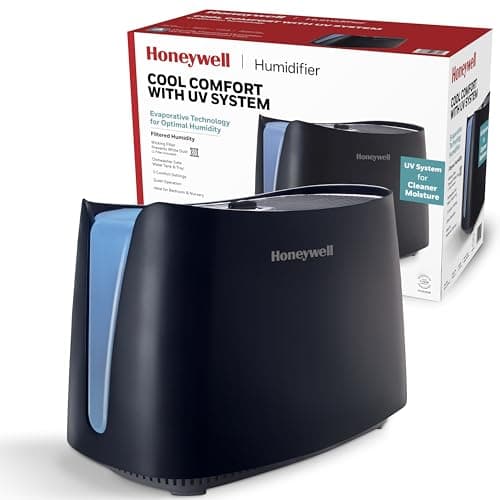 Honeywell HCM350 Germ Free Cool MoistureTop pickA break-resistant, dishwasher-safe tank and a wide opening. It is the only unit here designed so the hardest part of ownership is easy. | Cleaning, without qualification | 1.0implied · 296 sq ft | |
| 2 | 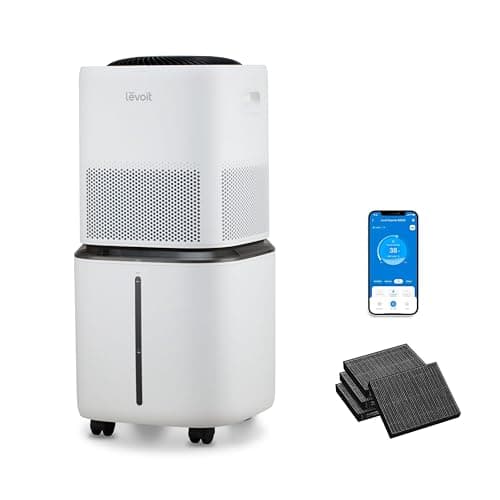 Levoit Superior 6000SSix gallons, evaporative, and a Dry Mode that dries the wicks between runs. The 3,000 sq ft claim needs five times the output its own run time implies. | Mist-free humidification with a drying cycle | 2.0implied · 592 sq ft | |
| 3 | 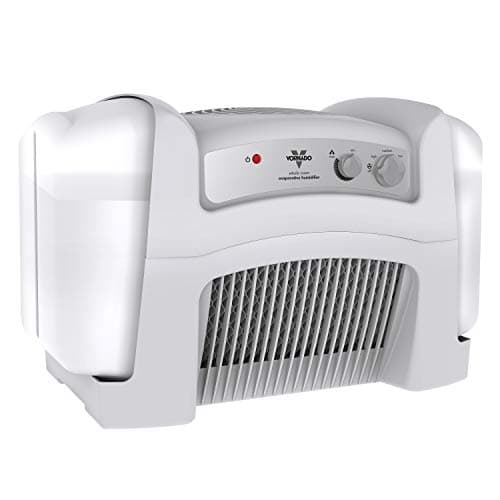 Vornado Evap40Vornado publishes an output figure and a coverage figure, and the two agree. Four gallons a day covers about 1,180 sq ft at our derived rate against a 1,000 sq ft claim. | The only coverage claim here the arithmetic supports | 4.0published · 1,184 sq ft | |
| 4 | 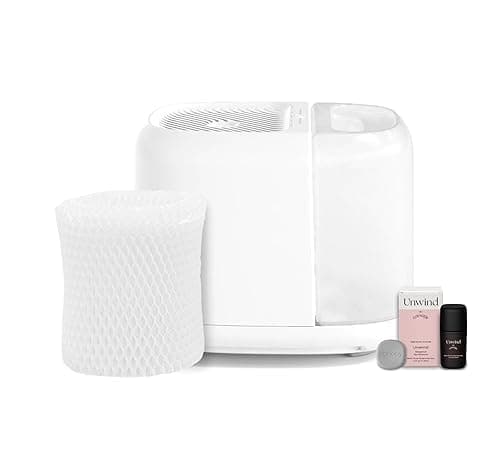 Canopy Large Room HumidifierEvaporative, no visible mist, dishwasher-safe tank, tray, cap and grill, and a fan that dries the unit between uses. Canopy publishes almost no numbers at all - no tank capacity, no output, no wattage. | Dishwasher-safe everything | not publishednothing to compute with | |
| 5 | 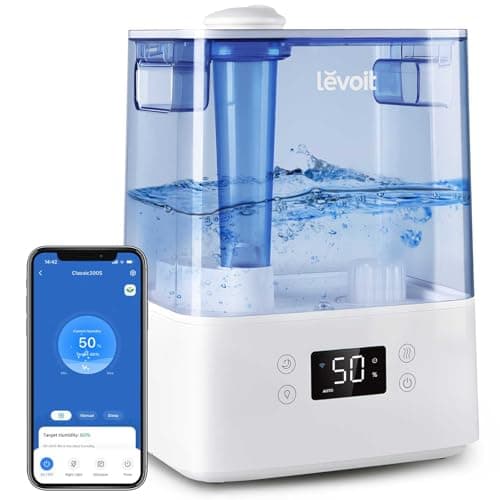 Levoit Classic 300SA 6-liter tank, a genuinely wide top-fill opening and no filter to buy. Its own numbers describe a 190 sq ft machine, not the 505 sq ft on the box. | A bedroom you refill twice a week | 0.63implied · 187 sq ft |
Most humidifier advice is written for comfort. A guitar room is a different brief: the target comes from the instrument's maker rather than from how the air feels, it is narrower than a comfort range, and the cost of getting it wrong is a cracked top rather than a dry throat.
It is also a brief where the makers have done the hard part for you. Two of the best-known acoustic guitar builders publish a target humidity, and they agree with each other. That turns this into a question with a checkable answer, which is rare in this category and worth building the whole page around.
We earn a commission if you buy through the links on this page, at no extra cost to you. It does not change what we recommend or the order the picks appear in. Full disclosure. Prices checked October 13, 2026.
| # | Product | Best for | Gal/day | Price |
|---|---|---|---|---|
| 1 | Honeywell HCM350 Germ Free Cool MoistureTop pickA break-resistant, dishwasher-safe tank and a wide opening. It is the only unit here designed so the hardest part of ownership is easy. | Cleaning, without qualification | 1.0implied · 296 sq ft | |
| 2 | Levoit Superior 6000SSix gallons, evaporative, and a Dry Mode that dries the wicks between runs. The 3,000 sq ft claim needs five times the output its own run time implies. | Mist-free humidification with a drying cycle | 2.0implied · 592 sq ft | |
| 3 | Vornado Evap40Vornado publishes an output figure and a coverage figure, and the two agree. Four gallons a day covers about 1,180 sq ft at our derived rate against a 1,000 sq ft claim. | The only coverage claim here the arithmetic supports | 4.0published · 1,184 sq ft | |
| 4 | Canopy Large Room HumidifierEvaporative, no visible mist, dishwasher-safe tank, tray, cap and grill, and a fan that dries the unit between uses. Canopy publishes almost no numbers at all - no tank capacity, no output, no wattage. | Dishwasher-safe everything | not publishednothing to compute with | |
| 5 | Levoit Classic 300SA 6-liter tank, a genuinely wide top-fill opening and no filter to buy. Its own numbers describe a 190 sq ft machine, not the 505 sq ft on the box. | A bedroom you refill twice a week | 0.63implied · 187 sq ft |
What guitar makers actually ask for
Taylor Guitars recommends 45 to 55 percent relative humidity and describes 40 to 60 percent as the acceptable range. It also states the conditions its own factory runs at: 74 degrees and 47 percent relative humidity. A guitar is built at a moisture content, and the further the room drifts from it, the more the wood moves.
Martin Guitar gives the same band - 45 to 55 percent relative humidity - with a temperature range of 72 to 77 degrees F, and says a room or case humidifier can help maintain it, particularly in colder months. Then it adds the sentence that should end any debate about whether this is worth doing: damage from conditions outside that range, especially dry ones, is not covered under warranty.
| Maker | Recommended | Outer limit | Stated consequence |
|---|---|---|---|
| Taylor Guitars | 45-55% RH | 40-60% acceptable | Act if above 60% for at least 72 hours |
| Martin Guitar | 45-55% RH at 72-77 F | Not stated | Damage outside the range not covered under warranty |
Why it has to be one room
Winter dryness is manufactured by your heating: cold air leaks in, gets warmed, and its relative humidity collapses. We walk through the physics on winter humidifiers. The consequence for a guitar owner is that the whole house is fighting you all season, and the load of holding every room at 50 percent is both large and a condensation problem.
A closed room is a much smaller problem. The door limits how much drier air mixes in, the volume is small enough that a modest machine can hold it, and you can run that room above the rest of the house without asking your windows everywhere else to tolerate it. This is why the query is "guitar room" and not "guitar house", and why a room humidifier is a reasonable tool for it.
- Keep the door closed. An open doorway turns a room problem back into a house problem.
- Watch the window. If the room has an exterior window, a room held at 50 percent in January can condense on it. Water on the glass means that window cannot tolerate that humidity, whatever the instruments want.
- Put the hygrometer beside the instruments. Not beside the humidifier - a sensor in or near the output reads the output, not the room.
Room humidifier or case humidifier?
We should be straight about this, because it changes what some readers should buy. Martin names both options. Taylor's own guidance on humidifying describes using a humidifier inside the case - placed in the open area of the case, with the guitar inside and the case closed.
If you own one or two guitars and keep them in their cases, a case humidifier is the cheaper and more targeted answer, and it is not a product we cover or sell. A small closed case is a far easier volume to hold than a room. Your guitar maker's own guidance is the place to start.
A room humidifier makes sense when the instruments live out of their cases - on stands, on wall hangers, in a studio - or when there are enough of them that managing a case humidifier for each one stops being practical. That is the reader this page is for.
How we ranked these
Criteria first, in order of how much damage getting each one wrong would do.
- Does it tend to stop on its own? Taylor's warning is about the top of the range - above 60 percent for 72 hours. In a small closed room, overshoot is the failure mode. Evaporative units are self-limiting: evaporation slows as the air approaches saturation. Ultrasonic units are not, and rely on a sensor to stop.
- Does anything come out of it besides water vapor? An ultrasonic unit on hard water atomizes minerals that settle as a fine white film - on a guitar's finish, on its hardware and inside the soundhole. An evaporative unit leaves them in the wick.
- Is it sized to a room, not a house? A machine far too large for a small closed room is a machine that spends its time fighting its own overshoot.
- Can it be kept clean? The EPA's instruction - empty and dry the tank daily, clean every water-contact surface every third day - applies in a music room exactly as anywhere else.
- How loud is it? In a room where you play and perhaps record, published noise figures with a setting attached matter more than they do in a hallway.
Sizing a guitar room
Guitar rooms are usually spare bedrooms or small studios, which puts the requirement well below a gallon a day on our standard method.
One honest caveat on those figures. Our rate is derived from Aprilaire's published capacity-and-coverage pairs, and those pairs do not state the target humidity they assume. Holding the top of a guitar maker's band in a heated room in January is a more demanding target than ordinary comfort, and we have no sourced multiplier for how much more. So size up from the figure above rather than down, and let a humidistat or a hygrometer - not the output rating - decide when the machine stops.
Why the Honeywell leads
It is the right size and the right mechanism for the room most guitar owners actually have. Its published tank and run time imply about 1.0 gallon a day, which serves roughly 296 square feet at our rate - comfortably above a spare bedroom's requirement, without being the kind of oversized machine that swings a small room around.
It is evaporative, so it tends toward equilibrium rather than running a closed room past 60 percent, and it puts no mineral film on a finish. Honeywell states the tank is dishwasher safe, break resistant and has a wide opening, which makes the every-third-day clean a rack rather than a scrub.
For a larger music room or studio
The Levoit Superior 6000S is the pick when the room is a proper studio rather than a spare bedroom. Its published tank and run time imply about 2.0 gallons a day - roughly 592 square feet at our rate - and it is evaporative, with a Dry Mode that Levoit says runs the fan to dry out the wick filters. A wick left damp between runs is where things grow, so that is automation aimed at a real problem.
Two cautions. Levoit claims 3,000 square feet, about five times what its own tank and run time imply, so size it on the 592 figure, not the box. And it publishes 28 to 45 dB - the honest disclosure of a range, and a reminder that the top of it is audible in a quiet room.
The Vornado Evap40 is for a big room with a lot of instruments. It is the one unit here whose coverage claim survives its own arithmetic: 4 gallons a day published, up to 1,000 square feet claimed, and about 1,184 square feet at our rate. The downside for this use is that it is far more machine than a spare bedroom needs, and Vornado publishes neither a wattage nor a run time.
The mist-free and the near-silent options
The Canopy Large Room is the easiest unit here to keep clean - tank, tray, cap and grill are dishwasher safe, and a fan dries the interior between runs. It is evaporative and mist-free, so nothing lands on the instruments. The problem for a guitar room is sizing: Canopy publishes no tank capacity and no output, so there is no way to check whether it suits a 150 square foot room or a 900 one. Its filter is on a published 45-day interval, which is four filters a heating season. We cover it fully in our Canopy review.
The Levoit Classic 300S is on this list for one reason: it is near-silent, rated at 30 dB or less, and a room where you play or record may need that. Its implied output of about 0.63 gallons a day serves roughly 187 square feet - a small room, sized honestly.
What too dry and too wet look like
Taylor publishes the symptoms on both sides, and they are worth knowing because the instrument will tell you before the hygrometer does.
| Too dry | Too wet |
|---|---|
| Low action - strings very close to the fretboard | High action |
| A hump on the fretboard where the neck joins the body | A dull sound |
| A sunken top between the bridge and fingerboard | A rippling feel on the tail section of the back |
| The back looks very flat | - |
| Sharp fret ends extending past the edge of the fretboard | - |
The asymmetry in that table is the point of this whole page. Dryness has more listed symptoms and more of them are structural. But the wet column exists, and a room humidifier in a small closed space is the most likely way a careful owner ends up in it. Hold the band; do not chase the top of it.
The routine, in short
- Measure first. A hygrometer next to the instruments for a few days, before buying anything.
- Close the room. One room held on its own, door shut.
- Size to the room and size up. Use the figure above as a floor, not a target.
- Aim for the middle of 45-55, not the top. Taylor's corrective threshold is above 60 for 72 hours; leave yourself room.
- Keep the output away from the instruments and the hygrometer beside them.
- Clean it on the EPA's schedule. A dirty humidifier in a closed room is concentrated in that room.
- Watch the window if the room has one, and turn down before it condenses.
The picks, in full
Top pick · Cleaning, without qualification
Honeywell HCM350 Germ Free Cool Moisture
A break-resistant, dishwasher-safe tank and a wide opening. It is the only unit here designed so the hardest part of ownership is easy.
One gallon over 24 hours is one gallon a day, which at our derived rate is about 296 square feet. Honeywell says medium room. Those two statements agree, which is a low bar that most of this category fails to clear.
The reason to buy it is the tank. Dishwasher-safe and break-resistant, with an opening wide enough to actually reach inside, against an EPA instruction to clean every third day. A humidifier you will genuinely clean twice a week beats a larger one you will clean twice a winter, and this is the only unit here whose maker treats that as a design requirement rather than a footnote.
There is one inconsistency worth naming. The specification table on Honeywell's own page says a 1 gallon tank; the feature copy a few hundred pixels above it says 1.1 gallons. It is a small discrepancy and it is on the maker's own page, which is a fair illustration of why we quote the table and say which one we took.
What works
- Dishwasher-safe, break-resistant tank with a wide opening, which is the whole ballgame for maintenance
- The wicking filter captures minerals, so no white dust regardless of your water
- The published tank and run time are consistent with the room size claimed
What does not
- HAC504 wicks are a recurring cost with no interval published on the product page
- One gallon a day is a bedroom, not a floor of a house
- The maker's own page states two different tank capacities
Skip this ifyou need to humidify an open-plan living space. This is a one-room machine and its own figures say so.
The arithmetic
- Implied output (continuous)
- 1.0 gal/day
- Covers, at 296 sq ft per gal/day
- 296 sq ft
Output derived as tank capacity divided by published run time, times 24. Coverage rate derived from Aprilaire’s own published capacity-and-coverage pairs.
Published specification
- Tank
- 1 galHoneywell's own specification table says 1 gallon; the marketing copy on the same page says 1.1. We quote the table.Source
- Output/day
- not publishedTank and run time only
- Coverage
- Medium roomHoneywell publishes a size class rather than a number. Its published tank and run time imply about 1 gallon per day, or roughly 296 sq ft at our derived rate.Source
- Run time
- Up to 24 hSource
- Power
- not published
- Filter
- HAC504 Filter AOne included. Honeywell states its own filters should be used.Source
- Cleaning
- Dishwasher safe, break resistant tank, wide openingHoneywell's own wording. It also states the wicking filter removes impurities from the water, reducing white dust.Source
#ad · how this is funded · price as of October 13, 2026
Pick 2 · Mist-free humidification with a drying cycle
Levoit Superior 6000S
Six gallons, evaporative, and a Dry Mode that dries the wicks between runs. The 3,000 sq ft claim needs five times the output its own run time implies.
Six gallons over 72 hours is two gallons a day, which covers about 590 square feet. The box says 3,000. To actually hold humidity across 3,000 square feet this unit would need to move a little over ten gallons a day, and at that rate its six-gallon reservoir would run dry in about fourteen hours. Both numbers describe the machine; only one describes it at a time, and the maker publishes no figure that reconciles them.
Dry Mode is the genuinely good idea here and it deserves credit. A wet wick sitting in a warm room is the substrate for everything the EPA warns about, and a fan cycle that dries the wicks between runs attacks that problem directly rather than adding an antimicrobial coating and hoping. It also extends wick life, which is the recurring cost.
Thirty watts to move two gallons a day is efficient, and mist-free operation means the minerals stay in the wicks rather than settling on your furniture. If you can live with a coverage claim you should mentally divide by five, this is a well-made machine.
What works
- Dry Mode addresses the real failure mode of evaporative units instead of masking it
- Mist-free, so no white dust whatever your water is like
- 30 W for six gallons of capacity, with noise published at both ends of the range
What does not
- The 3,000 sq ft claim is about five times what the published tank and run time imply
- Four wicks to replace, on an interval Levoit does not publish
- 45 dB at the top of the fan range is audible in a quiet bedroom
Skip this ifyou bought it for the 3,000 sq ft number. Size it at around 600 square feet on the setting whose run time Levoit actually publishes.
The arithmetic
- Implied output (low fan speed)
- 2.0 gal/day
- Covers, at 296 sq ft per gal/day
- 592 sq ft
- Maker’s coverage claim
- 3,000 sq ft
- Output that claim would need
- 10.1 gal/day
Output derived as tank capacity divided by published run time, times 24. Coverage rate derived from Aprilaire’s own published capacity-and-coverage pairs.
Published specification
- Tank
- 6 gal / 22.7 LSource
- Output/day
- not published
- Coverage
- 3,000 sq ft / 279 m23,000 sq ft needs about 10.1 gal/day at our derived rate. Its published tank and run time imply 2.0.Source
- Run time
- Up to 72 hOn the low fan speedSource
- Power
- 30 WSource
- Noise
- 28-45 dBSource
- Filter
- Four wick filters, pre-installedReplacements are sold by Levoit as a four-pack. No replacement interval is published.Source
- Cleaning
- Dry ModeLevoit's own wording: low and high fan speeds dry out the elevated wick filters, extending filter lifeSource
#ad · how this is funded · price as of October 13, 2026
Pick 3 · The only coverage claim here the arithmetic supports
Vornado Evap40
Vornado publishes an output figure and a coverage figure, and the two agree. Four gallons a day covers about 1,180 sq ft at our derived rate against a 1,000 sq ft claim.
Run the check that fails everywhere else on this page and it passes here. Four gallons a day at 296 square feet per gallon per day is about 1,180 square feet of coverage, against a claim of 1,000. Vornado left itself margin instead of taking it.
It passes because it is evaporative. A wick and a fan can only put as much water into the air as the air will accept, which is why an evaporative unit self-limits near 50% relative humidity and why it cannot produce white dust: the minerals stay in the wick. The EPA's guidance to use low-mineral water exists mainly because ultrasonic and impeller units disperse what is dissolved in the tank, and this design does not.
The cost of that is the wick. Two of them, on a schedule Vornado does not publish, which is the recurring bill an ultrasonic unit does not have. Whether that trade is worth it is arithmetic, and it is worked through in full on our filter-cost page.
What works
- Publishes an output figure, and the coverage claim survives being checked against it
- Evaporative, so it cannot produce white dust and self-limits near a safe humidity
- Five-year warranty, the longest published here
What does not
- Two wicks to replace on an interval Vornado does not publish
- A fan moving air across a wet wick is audible, and no dB figure is published
- No rated wattage published
Skip this ifyou want silence. Every evaporative unit is a fan, and Vornado publishes no noise figure for this one.
The arithmetic
- Published output (continuous on high)
- 4.0 gal/day
- Covers, at 296 sq ft per gal/day
- 1,184 sq ft
- Maker’s coverage claim
- 1,000 sq ft
- Output that claim would need
- 3.4 gal/day
Output as the manufacturer publishes it. Coverage rate derived from Aprilaire’s own published capacity-and-coverage pairs.
Published specification
- Tank
- 4 galSource
- Output/day
- Up to 4 galVornado's wording: up to a 4 gallon water output when operated continuously on highSource
- Coverage
- Up to 1,000 sq ftSupported by its own published output. This is the only unit in the set where that is true.Source
- Run time
- not publishedVornado publishes output instead, which is more useful
- Power
- not published
- Filter
- Two humidifying wicksTwo are supplied, one front and one rear. No replacement interval is published.Source
- Cleaning
- Vornado states easy to clean and operateSource
#ad · how this is funded · price as of October 13, 2026
Pick 4 · Dishwasher-safe everything
Canopy Large Room Humidifier
Evaporative, no visible mist, dishwasher-safe tank, tray, cap and grill, and a fan that dries the unit between uses. Canopy publishes almost no numbers at all - no tank capacity, no output, no wattage.
Canopy has built the machine around the maintenance problem rather than around a spec sheet, and it shows in both directions. Four components go in the dishwasher, the filter has a stated 45-day life rather than a vague 30-to-60, and a fan dries the interior between runs so there is less standing water to colonize in the first place.
What it does not have is a tank capacity. Canopy publishes a run time - 18 to 36 hours, depending on room humidity - but no tank volume, no output and no wattage, and a run time on its own cannot be turned into gallons per day. The 1,000 square foot claim is therefore the only unverifiable coverage figure on this page: with every other unit we can compute an implied output from the maker's own tank and run time and show you the gap. Here half the arithmetic is missing.
That is a real trade and worth stating plainly. You are buying a maintenance design and a subscription-shaped filter cadence, and giving up the ability to check the size claim. For a buyer whose actual failure mode is never cleaning the thing, that may be the right trade. It is not the right trade for someone sizing a room.
What works
- Four dishwasher-safe components, which no other unit here matches
- A published filter interval, which most of this set does not give you
- Airflow drying between uses attacks standing water directly
What does not
- No published tank capacity, output or wattage, so the size claim cannot be checked
- 45-day filter replacement is the most frequent schedule in this set
- The 1,000 sq ft claim cannot be checked against any manufacturer figure
Skip this ifyou want to verify the size claim before you buy. Nothing Canopy publishes lets you do that.
The arithmetic
There is none to do. This maker publishes no tank capacity, no output and no run time, so there is no figure of its own to check its coverage claim against. That is the finding.
Published specification
- Tank
- not publishedCanopy publishes no tank capacity. Retail listings state 5.5 L; we do not treat a retailer figure as a manufacturer specification.
- Output/day
- not published
- Coverage
- Up to 1,000 sq ft1,000 sq ft needs about 3.4 gal/day at our derived rate. Canopy publishes a run time but no tank capacity or output, and a run time alone cannot be turned into gallons per day, so the claim still cannot be checked.Source
- Run time
- 18-36 hCanopy gives a range rather than a figure, and ties it to room humidity. Without a published tank capacity it still cannot be turned into an output.Source
- Power
- not published
- Filter
- Antimicrobial filter, replaced every 45 daysCanopy's own stated interval. It is the only firm replacement interval published by any maker in this set.Source
- Cleaning
- Tank, tray, cap and grill are dishwasher safeCanopy's Smart Persistent Airflow runs a fan whenever moisture is detected inside the unit, nearly drying it out between usesSource
#ad · how this is funded · price as of October 13, 2026
Pick 5 · A bedroom you refill twice a week
Levoit Classic 300S
A 6-liter tank, a genuinely wide top-fill opening and no filter to buy. Its own numbers describe a 190 sq ft machine, not the 505 sq ft on the box.
The interesting number is not 6 liters, it is 60 hours. A 1.58-gallon tank that lasts 60 hours on low is moving 0.63 gallons of water a day, and 0.63 gallons a day is what covers about 187 square feet at the rate we derive from Aprilaire's own published sizing. That is a bedroom. It is not the 505 square feet on the specification table.
Both figures are true and they describe different settings. Levoit publishes the endurance of the quietest setting and the ceiling of the loudest, and never the output that connects them, so a buyer has no way to check the coverage claim. That is not a Levoit problem, it is a category problem, and it is the reason every roundup here shows the implied figure beside the claimed one.
What you are actually buying is the absence of a filter. No wick means no 30-to-60-day replacement cycle and no annual filter bill, and it also means every mineral in your tap water leaves the machine as white dust or stays behind as scale. Run low-mineral water or accept the descaling, which the EPA's own humidifier guidance is blunt about.
What works
- No wick or replacement filter, so the running cost after purchase is water and 26 watts
- 26 W is genuinely low: at the June 2026 US average tariff a full heating season of overnight running is a few dollars
- The top-fill opening is wide enough to get a hand and a brush inside, which is most of what makes a humidifier easy to keep clean
What does not
- The 505 sq ft coverage claim cannot be reconciled with the published tank and run time
- Ultrasonic, so hard water becomes airborne white dust unless you use low-mineral water
- Levoit publishes no gallons-per-day figure at any setting
Skip this ifyour water is hard and you will not commit to distilled. An ultrasonic unit atomizes whatever is dissolved in the tank, and this one has no wick to catch it.
The arithmetic
- Implied output (low mist)
- 0.63 gal/day
- Covers, at 296 sq ft per gal/day
- 187 sq ft
- Maker’s coverage claim
- 505 sq ft
- Output that claim would need
- 1.7 gal/day
Output derived as tank capacity divided by published run time, times 24. Coverage rate derived from Aprilaire’s own published capacity-and-coverage pairs.
Published specification
- Tank
- 1.58 gal / 6 LSource
- Output/day
- not publishedLevoit publishes tank size and low-setting run time, not gallons per day
- Coverage
- 215-505 sq ft / 20-47 m2Levoit's own figure. Its published tank and run time imply roughly 187 sq ft at our derived rate.Source
- Run time
- Up to 60 hOn the low mist settingSource
- Power
- 26 WAC 120 V, 60 HzSource
- Noise
- 30 dB or lessSource
- Filter
- None requiredA water filter sponge is included and descaling pads are sold separately, but there is no wick to replaceSource
- Cleaning
- Top-fill opening, brush includedLevoit's own wording: refill without flipping the tank overSource
#ad · how this is funded · price as of October 13, 2026
Questions people actually ask
What humidity should a guitar room be?
45 to 55 percent relative humidity. Taylor Guitars and Martin Guitar both publish that range; Taylor describes 40 to 60 percent as acceptable and its factory runs at 74 degrees and 47 percent. Martin pairs its range with 72 to 77 degrees F.
Is a room humidifier or a case humidifier better for a guitar?
For one or two guitars kept in their cases, a case humidifier is the cheaper and more targeted option - a closed case is a much smaller volume to hold, and Taylor's own guidance describes humidifying inside the case. A room humidifier makes more sense when instruments live on stands or wall hangers, or there are several of them. Martin says either can help in colder months.
Can a humidifier damage a guitar?
It can, by overshooting. Taylor lists high action, a dull sound and a rippling feel on the back as signs of an over-humidified guitar, and advises corrective action after 72 hours above 60 percent. An ultrasonic humidifier on hard water can also deposit a mineral film on the finish. Keep the output pointed away from instruments and a hygrometer beside them.
How do I know if my guitar is too dry?
Taylor lists low action, a hump on the fretboard where the neck joins the body, a sunken top between the bridge and fingerboard, a very flat-looking back, and sharp fret ends extending past the edge of the fretboard. Those are worth checking before the damage becomes a crack.
Does a guitar warranty cover humidity damage?
Martin states that damage from conditions outside its recommended range - especially dry environments - is not covered under warranty. Check your own maker's terms, but assume that humidity damage is your cost rather than theirs.
What size humidifier do I need for a guitar room?
A spare bedroom needs well under a gallon a day on our method - about 0.51 for 150 square feet at an 8 foot ceiling. Because a guitar maker's target is higher than ordinary comfort and we have no sourced multiplier for that, size up from the figure and let a hygrometer or humidistat decide when the machine stops.
Sources
Every figure on this page came from one of the documents below, read on the date shown. We do not cite other review sites, forum posts or video reviews as sources of fact.
- Taylor Guitars - Symptoms of a Dry Guitar (recommends 45-55 percent relative humidity; states its factory runs at 74 degrees and 47 percent relative humidity; lists low action, a hump where the neck joins the body, a sunken top, a flat back and sharp fret ends)
- Taylor Guitars - Spot and Fix an Over-Humidified Guitar (acceptable range 40-60 percent; lists high action, a dull sound and a rippling feel on the back; advises corrective action after 72 hours above 60 percent)
- Martin Guitar - FAQs (recommends 45-55 percent relative humidity at 72-77 degrees F; states a room or case humidifier can help in colder months; damage from conditions outside that range is not covered under warranty)
- US Environmental Protection Agency - Use and Care of Home Humidifiers (relative humidity ceiling, three-day cleaning interval, low-mineral water, microorganism warning)
- AHRI Guideline F - Selection, Installation and Servicing of Residential Humidifiers (the residential sizing standard; ahrinet.org returned HTTP 403 to this build, so we cite it as the governing document without paraphrasing text we did not read)
- Honeywell HCM350 - manufacturer spec page (retrieved September 1, 2026)
- Levoit Superior 6000S - manufacturer spec page (retrieved September 1, 2026)
- Vornado Evap40 - manufacturer spec page (retrieved September 1, 2026)
- Canopy Humidifier - manufacturer spec page (retrieved September 1, 2026)
- Levoit Classic 300S - manufacturer spec page (retrieved September 1, 2026)
Read next

Wood and instruments
Humidifiers for hardwood floors
Protecting wooden floors and furniture: the band to hold, why overshooting is the bigger risk, and the machines suited to steady control.
Top pick: Vornado Evap40 · 4.0 gal/day
#ad · how this is funded · price as of October 13, 2026

Ideal indoor humidity in winter
The 30-50% relative humidity band, the EPA's stated ceiling, and the window-condensation limit that overrides it in cold weather.
Best for winter
Best humidifiers for winter
Winter picks sized against the heating season rather than a room label, with the physics of why heated air gets dry and what that means for the output you need.
Top pick: Vornado Evap40 · 4.0 gal/day
#ad · how this is funded · price as of October 13, 2026

White dust: your water, made airborne
What white dust is, why only ultrasonic and impeller units produce it, and the three fixes ranked by how well they work.
Found a number that is wrong? Tell us and we will fix it and say so. How we pick shows every formula used on this page.