Picks
Humidifiers for hardwood floors
Wood is hygroscopic: it takes up moisture and gives it back, and it changes size doing it. The goal is stability rather than maximum humidity, and that changes which machine you want.
By Scooter M. · Published · Updated
We earn a commission if you buy through the links on this page, at no extra cost to you. It does not change what we recommend or the order the picks appear in. Full disclosure. Prices checked October 16, 2026.
| # | Product | Best for | Gal/day | Price |
|---|---|---|---|---|
| 1 | 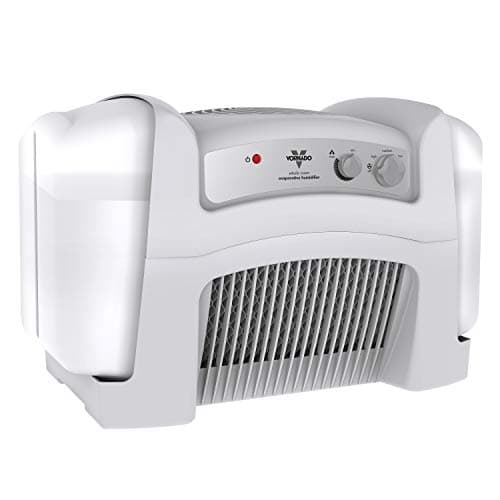 Vornado Evap40Top pickVornado publishes an output figure and a coverage figure, and the two agree. Four gallons a day covers about 1,180 sq ft at our derived rate against a 1,000 sq ft claim. | The only coverage claim here the arithmetic supports | 4.0published · 1,184 sq ft | |
| 2 | 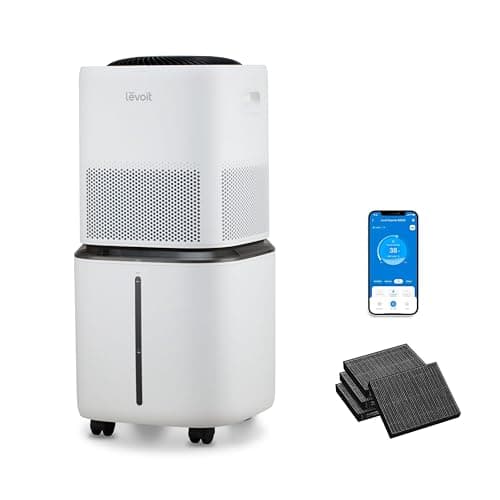 Levoit Superior 6000SSix gallons, evaporative, and a Dry Mode that dries the wicks between runs. The 3,000 sq ft claim needs five times the output its own run time implies. | Mist-free humidification with a drying cycle | 2.0implied · 592 sq ft | |
| 3 | 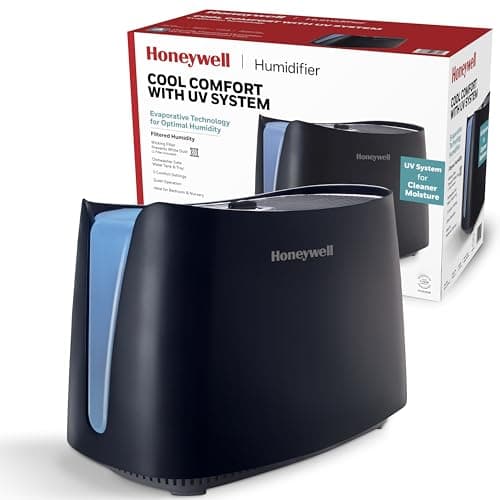 Honeywell HCM350 Germ Free Cool MoistureA break-resistant, dishwasher-safe tank and a wide opening. It is the only unit here designed so the hardest part of ownership is easy. | Cleaning, without qualification | 1.0implied · 296 sq ft | |
| 4 | 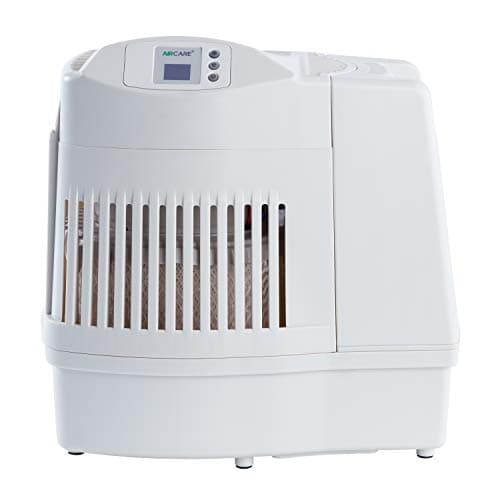 AIRCARE MA0800 Mini-ConsoleA 2.5-gallon evaporative console with three fan speeds, an adjustable humidistat and a MAF2 SuperWick. Its 2,600 sq ft claim is far beyond what its own tank and run time imply, so size it as a large room rather than a floor. | A plug-in console with its own humidistat | 1.7implied · 493 sq ft |
Wood is hygroscopic. It absorbs moisture from the air when the air is damp and releases it when the air is dry, and it changes dimension as it does. Every seasonal gap in a floorboard, every stuck door in August, every guitar that goes sharp in January is that mechanism at work.
The point of humidifying for wood is therefore stability, not maximum. A floor held steadily at 38 percent all winter is far better off than one swinging between 20 and 55 - and the second scenario is what a large, uncontrolled humidifier produces.
We earn a commission if you buy through the links on this page, at no extra cost to you. It does not change what we recommend or the order the picks appear in. Full disclosure. Prices checked October 16, 2026.
| # | Product | Best for | Gal/day | Price |
|---|---|---|---|---|
| 1 | Vornado Evap40Top pickVornado publishes an output figure and a coverage figure, and the two agree. Four gallons a day covers about 1,180 sq ft at our derived rate against a 1,000 sq ft claim. | The only coverage claim here the arithmetic supports | 4.0published · 1,184 sq ft | |
| 2 | Levoit Superior 6000SSix gallons, evaporative, and a Dry Mode that dries the wicks between runs. The 3,000 sq ft claim needs five times the output its own run time implies. | Mist-free humidification with a drying cycle | 2.0implied · 592 sq ft | |
| 3 | Honeywell HCM350 Germ Free Cool MoistureA break-resistant, dishwasher-safe tank and a wide opening. It is the only unit here designed so the hardest part of ownership is easy. | Cleaning, without qualification | 1.0implied · 296 sq ft | |
| 4 | AIRCARE MA0800 Mini-ConsoleA 2.5-gallon evaporative console with three fan speeds, an adjustable humidistat and a MAF2 SuperWick. Its 2,600 sq ft claim is far beyond what its own tank and run time imply, so size it as a large room rather than a floor. | A plug-in console with its own humidistat | 1.7implied · 493 sq ft |
The band
The EPA's ceiling of 50 percent relative humidity applies here as everywhere, and for wood the more useful target sits in the middle of the band, around 35 to 45 percent, held steadily. Flooring manufacturers publish their own recommended ranges for their specific products, and if you have a warranty on a floor, theirs is the number that matters rather than any general figure.
Why these picks
Three properties matter for wood, and they point at evaporative units.
- Self-limiting output. An evaporative wick can only give up as much water as the surrounding air will accept, so the machine slows down as the room approaches saturation. For a room full of wood that is a genuine safeguard against the failure mode you actually fear.
- No visible mist. An ultrasonic unit produces a plume that settles on nearby surfaces. Pointing that at a wooden floor or a piano is a bad idea entirely separate from the room's relative humidity.
- No white dust. Fine mineral dust settling on a finished floor is abrasive underfoot, and it is not something you want to be dry-mopping around every week. White dust.
The Vornado Evap40 leads because it publishes an output figure - 4 gallons a day on continuous high - so you can size a whole floor against it rather than guessing. The Superior 6000S is mist-free with a drying cycle. The Honeywell is the bedroom-scale option, and the AIRCARE console is a humidistat-controlled option for a large room.
Sizing for a floor rather than a room
Placement matters more here
- Never aim a humidifier at a wooden floor or wooden furniture. Whatever the room average is, the boards directly under a mist plume are getting far more than that.
- Raise it off the floor. A unit on a hard floor puts its plume at the level you least want it.
- Keep it away from cold outside walls and windows, where condensation forms first and where water can run down onto skirting and floor edges.
- Put the hygrometer at floor level, away from the machine. That is where the wood is.
Instruments
The same physics, tighter tolerances, and a different scale of consequence. Guitars, pianos and violins are built as assemblies of thin wood under tension, and they respond to humidity swings faster and less forgivingly than a floor does.
The practical approach is the same one used for a room of wood - hold the band steadily, prefer a self-limiting machine, keep the plume away from the instrument - with the addition that instrument makers publish their own ranges and those are more specific than anything we would offer. A room humidifier plus a hygrometer beside the instrument is the sensible starting point. What Taylor and Martin actually publish, and how to hold one closed room at that range, is on humidifiers for a guitar room.
Do not forget the machine itself
A humidifier standing on or near a wooden floor is a container of water, and the ones that get neglected end up with a bacterial film and, eventually, a leak. Put it on a tray, keep to the EPA's every-third-day schedule, and empty and dry it daily.
The picks, in full
Top pick · The only coverage claim here the arithmetic supports
Vornado Evap40
Vornado publishes an output figure and a coverage figure, and the two agree. Four gallons a day covers about 1,180 sq ft at our derived rate against a 1,000 sq ft claim.
Run the check that fails everywhere else on this page and it passes here. Four gallons a day at 296 square feet per gallon per day is about 1,180 square feet of coverage, against a claim of 1,000. Vornado left itself margin instead of taking it.
It passes because it is evaporative. A wick and a fan can only put as much water into the air as the air will accept, which is why an evaporative unit self-limits near 50% relative humidity and why it cannot produce white dust: the minerals stay in the wick. The EPA's guidance to use low-mineral water exists mainly because ultrasonic and impeller units disperse what is dissolved in the tank, and this design does not.
The cost of that is the wick. Two of them, on a schedule Vornado does not publish, which is the recurring bill an ultrasonic unit does not have. Whether that trade is worth it is arithmetic, and it is worked through in full on our filter-cost page.
What works
- Publishes an output figure, and the coverage claim survives being checked against it
- Evaporative, so it cannot produce white dust and self-limits near a safe humidity
- Five-year warranty, the longest published here
What does not
- Two wicks to replace on an interval Vornado does not publish
- A fan moving air across a wet wick is audible, and no dB figure is published
- No rated wattage published
Skip this ifyou want silence. Every evaporative unit is a fan, and Vornado publishes no noise figure for this one.
The arithmetic
- Published output (continuous on high)
- 4.0 gal/day
- Covers, at 296 sq ft per gal/day
- 1,184 sq ft
- Maker’s coverage claim
- 1,000 sq ft
- Output that claim would need
- 3.4 gal/day
Output as the manufacturer publishes it. Coverage rate derived from Aprilaire’s own published capacity-and-coverage pairs.
Published specification
- Tank
- 4 galSource
- Output/day
- Up to 4 galVornado's wording: up to a 4 gallon water output when operated continuously on highSource
- Coverage
- Up to 1,000 sq ftSupported by its own published output. This is the only unit in the set where that is true.Source
- Run time
- not publishedVornado publishes output instead, which is more useful
- Power
- not published
- Filter
- Two humidifying wicksTwo are supplied, one front and one rear. No replacement interval is published.Source
- Cleaning
- Vornado states easy to clean and operateSource
#ad · how this is funded · price as of October 16, 2026
Pick 2 · Mist-free humidification with a drying cycle
Levoit Superior 6000S
Six gallons, evaporative, and a Dry Mode that dries the wicks between runs. The 3,000 sq ft claim needs five times the output its own run time implies.
Six gallons over 72 hours is two gallons a day, which covers about 590 square feet. The box says 3,000. To actually hold humidity across 3,000 square feet this unit would need to move a little over ten gallons a day, and at that rate its six-gallon reservoir would run dry in about fourteen hours. Both numbers describe the machine; only one describes it at a time, and the maker publishes no figure that reconciles them.
Dry Mode is the genuinely good idea here and it deserves credit. A wet wick sitting in a warm room is the substrate for everything the EPA warns about, and a fan cycle that dries the wicks between runs attacks that problem directly rather than adding an antimicrobial coating and hoping. It also extends wick life, which is the recurring cost.
Thirty watts to move two gallons a day is efficient, and mist-free operation means the minerals stay in the wicks rather than settling on your furniture. If you can live with a coverage claim you should mentally divide by five, this is a well-made machine.
What works
- Dry Mode addresses the real failure mode of evaporative units instead of masking it
- Mist-free, so no white dust whatever your water is like
- 30 W for six gallons of capacity, with noise published at both ends of the range
What does not
- The 3,000 sq ft claim is about five times what the published tank and run time imply
- Four wicks to replace, on an interval Levoit does not publish
- 45 dB at the top of the fan range is audible in a quiet bedroom
Skip this ifyou bought it for the 3,000 sq ft number. Size it at around 600 square feet on the setting whose run time Levoit actually publishes.
The arithmetic
- Implied output (low fan speed)
- 2.0 gal/day
- Covers, at 296 sq ft per gal/day
- 592 sq ft
- Maker’s coverage claim
- 3,000 sq ft
- Output that claim would need
- 10.1 gal/day
Output derived as tank capacity divided by published run time, times 24. Coverage rate derived from Aprilaire’s own published capacity-and-coverage pairs.
Published specification
- Tank
- 6 gal / 22.7 LSource
- Output/day
- not published
- Coverage
- 3,000 sq ft / 279 m23,000 sq ft needs about 10.1 gal/day at our derived rate. Its published tank and run time imply 2.0.Source
- Run time
- Up to 72 hOn the low fan speedSource
- Power
- 30 WSource
- Noise
- 28-45 dBSource
- Filter
- Four wick filters, pre-installedReplacements are sold by Levoit as a four-pack. No replacement interval is published.Source
- Cleaning
- Dry ModeLevoit's own wording: low and high fan speeds dry out the elevated wick filters, extending filter lifeSource
#ad · how this is funded · price as of October 16, 2026
Pick 3 · Cleaning, without qualification
Honeywell HCM350 Germ Free Cool Moisture
A break-resistant, dishwasher-safe tank and a wide opening. It is the only unit here designed so the hardest part of ownership is easy.
One gallon over 24 hours is one gallon a day, which at our derived rate is about 296 square feet. Honeywell says medium room. Those two statements agree, which is a low bar that most of this category fails to clear.
The reason to buy it is the tank. Dishwasher-safe and break-resistant, with an opening wide enough to actually reach inside, against an EPA instruction to clean every third day. A humidifier you will genuinely clean twice a week beats a larger one you will clean twice a winter, and this is the only unit here whose maker treats that as a design requirement rather than a footnote.
There is one inconsistency worth naming. The specification table on Honeywell's own page says a 1 gallon tank; the feature copy a few hundred pixels above it says 1.1 gallons. It is a small discrepancy and it is on the maker's own page, which is a fair illustration of why we quote the table and say which one we took.
What works
- Dishwasher-safe, break-resistant tank with a wide opening, which is the whole ballgame for maintenance
- The wicking filter captures minerals, so no white dust regardless of your water
- The published tank and run time are consistent with the room size claimed
What does not
- HAC504 wicks are a recurring cost with no interval published on the product page
- One gallon a day is a bedroom, not a floor of a house
- The maker's own page states two different tank capacities
Skip this ifyou need to humidify an open-plan living space. This is a one-room machine and its own figures say so.
The arithmetic
- Implied output (continuous)
- 1.0 gal/day
- Covers, at 296 sq ft per gal/day
- 296 sq ft
Output derived as tank capacity divided by published run time, times 24. Coverage rate derived from Aprilaire’s own published capacity-and-coverage pairs.
Published specification
- Tank
- 1 galHoneywell's own specification table says 1 gallon; the marketing copy on the same page says 1.1. We quote the table.Source
- Output/day
- not publishedTank and run time only
- Coverage
- Medium roomHoneywell publishes a size class rather than a number. Its published tank and run time imply about 1 gallon per day, or roughly 296 sq ft at our derived rate.Source
- Run time
- Up to 24 hSource
- Power
- not published
- Filter
- HAC504 Filter AOne included. Honeywell states its own filters should be used.Source
- Cleaning
- Dishwasher safe, break resistant tank, wide openingHoneywell's own wording. It also states the wicking filter removes impurities from the water, reducing white dust.Source
#ad · how this is funded · price as of October 16, 2026
Pick 4 · A plug-in console with its own humidistat
AIRCARE MA0800 Mini-Console
A 2.5-gallon evaporative console with three fan speeds, an adjustable humidistat and a MAF2 SuperWick. Its 2,600 sq ft claim is far beyond what its own tank and run time imply, so size it as a large room rather than a floor.
Two published figures that describe opposite ends of the machine, and none of the numbers that would join them up. A 2.5-gallon tank lasting 36 hours is about 1.67 gallons a day, or roughly 493 square feet at our derived rate. Covering the claimed 2,600 square feet would take about 8.8 gallons a day, at which rate the same tank empties in under seven hours.
Both can be true at once: 36 hours is AIRCARE's maximum run time, which will be the lowest of the three fan speeds, and 2,600 square feet will be the highest. It can certainly move more than 1.67 gallons a day on a higher speed. AIRCARE does not say how much more, so its own published data supports sizing it as a large room, not a whole floor.
What it has that most units in our set do not is an adjustable humidistat with digital controls, stated on AIRCARE's own page. On an evaporative machine, which already slows down as the air approaches saturation, that is a second brake against overshooting - and the MAF2 SuperWick keeps your tap water's minerals out of the air.
What works
- Adjustable humidistat and digital controls, per AIRCARE's own specification
- Evaporative SuperWick captures minerals, so no white dust
- Three fan speeds to trade output against noise
What does not
- No published output figure anywhere on the manufacturer page
- The 2,600 sq ft claim and the 36-hour run time cannot both describe the same setting
- No published noise figure, wattage or wick replacement interval
Skip this ifyou want to humidify a whole floor on the strength of the box. Its own tank and run time support a large room, not 2,600 square feet.
The arithmetic
- Implied output (maximum published run time)
- 1.7 gal/day
- Covers, at 296 sq ft per gal/day
- 493 sq ft
- Maker’s coverage claim
- 2,600 sq ft
- Output that claim would need
- 8.8 gal/day
Output derived as tank capacity divided by published run time, times 24. Coverage rate derived from Aprilaire’s own published capacity-and-coverage pairs.
Published specification
- Tank
- 2.5 galSource
- Output/day
- not publishedAIRCARE's page gives a tank capacity and a maximum run time, but no daily output.
- Coverage
- Up to 2,600 sq ft2,600 sq ft needs about 8.8 gal/day at our derived rate. AIRCARE publishes no output figure, so the claim cannot be checked against its own data.Source
- Run time
- Up to 36 hAIRCARE's maximum run time, which will describe the lowest of its three fan speedsSource
- Power
- not published
- Filter
- MAF2 SuperWickAIRCARE publishes no replacement intervalSource
- Cleaning
- Evaporative wick holds minerals back from the roomAdjustable humidistat and digital controls, per AIRCARESource
#ad · how this is funded · price as of October 16, 2026
Questions people actually ask
What humidity level is best for hardwood floors?
Steady, and in the middle of the EPA's 30 to 50 percent band - around 35 to 45 percent is the usual target. Stability matters more than the exact figure, because it is the swings that move the wood. If your floor has a warranty, the manufacturer's own stated range takes precedence over any general figure.
Is a humidifier bad for hardwood floors?
Only if it overshoots. Dry air shrinks boards and opens gaps, which is unsightly and reverses. Too much moisture swells them, and if they run out of expansion room they cup or buckle, which does not reverse. Keep under 50 percent, never aim the unit at the floor, and put it on a tray.
What type of humidifier is best for wood floors?
Evaporative. It self-limits as the air approaches saturation, produces no visible mist that could settle on the boards, and does not disperse mineral dust onto a finished surface. The Vornado Evap40 is the pick because it also publishes an output figure, so a floor can be sized against it.
Do I need a humidifier for a guitar or piano?
Wooden instruments respond to humidity swings faster and less forgivingly than floors do, so a stable room helps. Instrument makers publish their own recommended ranges and those are more specific than a general figure - follow theirs, keep a hygrometer beside the instrument, and never point a mist plume at it.
Sources
Every figure on this page came from one of the documents below, read on the date shown. We do not cite other review sites, forum posts or video reviews as sources of fact.
- US Environmental Protection Agency - Use and Care of Home Humidifiers (relative humidity ceiling, three-day cleaning interval, low-mineral water, microorganism warning)
- Vornado Evap40 - manufacturer spec page (retrieved September 1, 2026)
- Levoit Superior 6000S - manufacturer spec page (retrieved September 1, 2026)
- Honeywell HCM350 - manufacturer spec page (retrieved September 1, 2026)
- AIRCARE MA0800 Mini-Console - manufacturer spec page (retrieved September 17, 2026)
Read next

Ideal indoor humidity in winter
The 30-50% relative humidity band, the EPA's stated ceiling, and the window-condensation limit that overrides it in cold weather.
Evaporative
Evaporative humidifiers
How evaporative humidifiers work, the self-limiting property that makes them safer, and the wick bill that is their real cost.
Top pick: Vornado Evap40 · 4.0 gal/day
#ad · how this is funded · price as of October 16, 2026
Humidifier sizing chart by square footage
The sizing chart in gallons per day, by floor area and ceiling height, with a companion table of what each figure means in practice.
Best for a guitar room
Best humidifiers for a guitar room
Room humidifiers for instruments, chosen against what guitar makers actually publish: a 45-55% target, a warning about going above 60, and a warranty that does not cover humidity damage.
Top pick: Honeywell HCM350 Germ Free Cool Moisture · 1.0 gal/day
#ad · how this is funded · price as of October 16, 2026
Reviewed
Vornado Evap40 review
A full review of the Vornado Evap40: the published output that makes it the only portable whose coverage claim survives checking, the five-year cover, and the two specifications Vornado omits.
Top pick: Vornado Evap40 · 4.0 gal/day
#ad · how this is funded · price as of October 16, 2026
Where to put a humidifier
Where to put a humidifier, and why: what the clearance around it is actually for, why off the floor is the default and consoles are the exception, the surfaces to keep it away from, and the three faults placement cannot fix.
Top pick: Vornado Evap40 · 4.0 gal/day
#ad · how this is funded · price as of October 16, 2026
Found a number that is wrong? Tell us and we will fix it and say so. How we pick shows every formula used on this page.