Picks
Best humidifiers for plants
This is the one page on the site where we recommend against evaporative humidifiers. Plants want humidity above the level an evaporative unit can physically reach, and that changes the answer.
By Scooter M. · Published · Updated
We earn a commission if you buy through the links on this page, at no extra cost to you. It does not change what we recommend or the order the picks appear in. Full disclosure. Prices checked October 13, 2026.
| # | Product | Best for | Gal/day | Price |
|---|---|---|---|---|
| 1 | 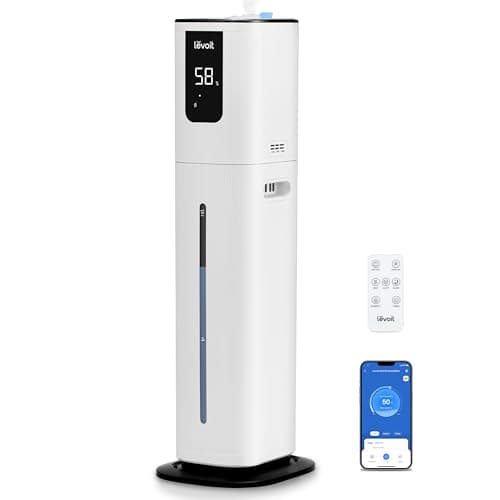 Levoit OasisMist 1000STop pickTen liters and a published 100-hour run time, which is four nights of not thinking about it. The coverage claim is still ahead of the arithmetic. | Long stretches between refills | 0.62implied · 185 sq ft | |
| 2 | 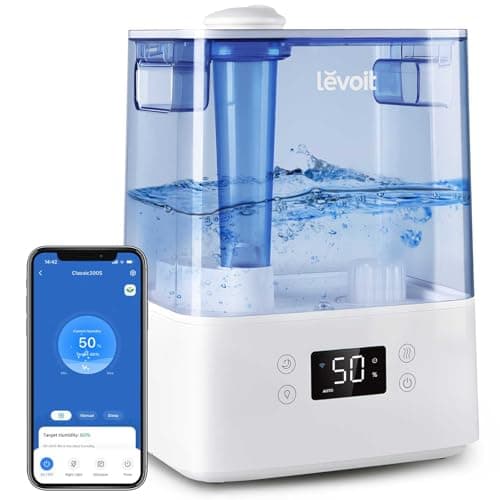 Levoit Classic 300SA 6-liter tank, a genuinely wide top-fill opening and no filter to buy. Its own numbers describe a 190 sq ft machine, not the 505 sq ft on the box. | A bedroom you refill twice a week | 0.63implied · 187 sq ft | |
| 3 | 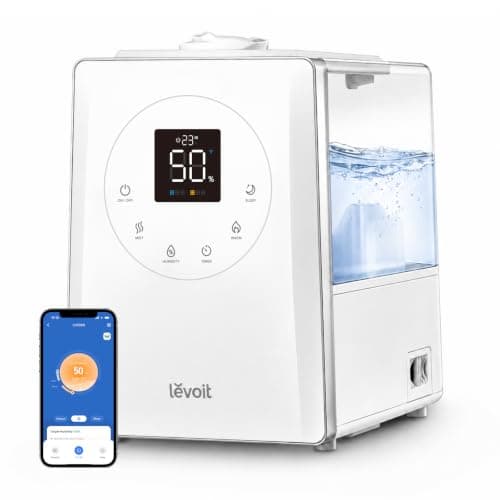 Levoit LV600S HybridWarm and cool mist from a 6-liter tank, and the only Levoit in this set that publishes a maximum output. On warm mist it genuinely covers a floor of a house. | The one unit here that publishes an output figure | 3.5published · 1,033 sq ft | |
| 4 | 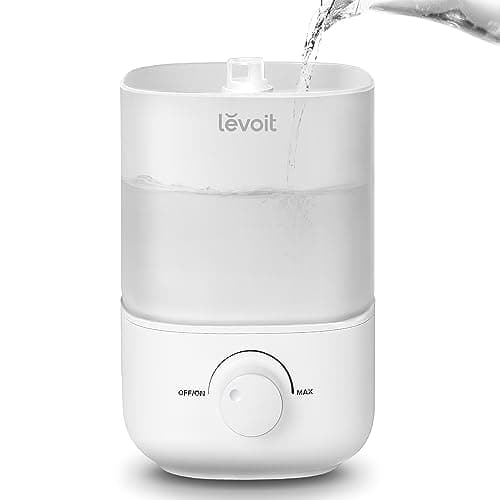 Levoit Classic 1602.5 liters, 17 watts, and a base with no hard-to-reach corners. The smallest honest recommendation here, and the only one whose maker declines to claim a coverage figure at all. | A desk, a nursery corner, a small bedroom | 0.63implied · 188 sq ft | |
| 5 | 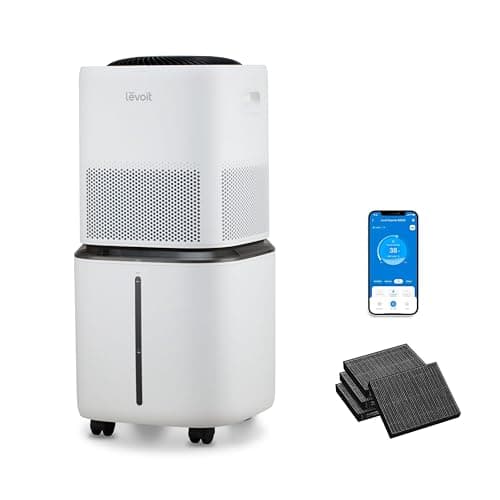 Levoit Superior 6000SSix gallons, evaporative, and a Dry Mode that dries the wicks between runs. The 3,000 sq ft claim needs five times the output its own run time implies. | Mist-free humidification with a drying cycle | 2.0implied · 592 sq ft |
Almost everything else on this site points you toward an evaporative humidifier. It cannot make white dust, it runs on tap water, and it self-limits as the air approaches saturation so it will not push a room somewhere unhealthy. Four of our five other roundups lead with one.
For plants that advice reverses, and it reverses for a specific physical reason rather than a preference. The self-limiting behavior that makes an evaporative unit safe in a bedroom is exactly what stops it reaching the humidity a tropical houseplant is asking for. If you want a plant corner meaningfully wetter than the rest of the room, you need a machine that will keep going, and that means ultrasonic.
We earn a commission if you buy through the links on this page, at no extra cost to you. It does not change what we recommend or the order the picks appear in. Full disclosure. Prices checked October 13, 2026.
| # | Product | Best for | Gal/day | Price |
|---|---|---|---|---|
| 1 | Levoit OasisMist 1000STop pickTen liters and a published 100-hour run time, which is four nights of not thinking about it. The coverage claim is still ahead of the arithmetic. | Long stretches between refills | 0.62implied · 185 sq ft | |
| 2 | Levoit Classic 300SA 6-liter tank, a genuinely wide top-fill opening and no filter to buy. Its own numbers describe a 190 sq ft machine, not the 505 sq ft on the box. | A bedroom you refill twice a week | 0.63implied · 187 sq ft | |
| 3 | Levoit LV600S HybridWarm and cool mist from a 6-liter tank, and the only Levoit in this set that publishes a maximum output. On warm mist it genuinely covers a floor of a house. | The one unit here that publishes an output figure | 3.5published · 1,033 sq ft | |
| 4 | Levoit Classic 1602.5 liters, 17 watts, and a base with no hard-to-reach corners. The smallest honest recommendation here, and the only one whose maker declines to claim a coverage figure at all. | A desk, a nursery corner, a small bedroom | 0.63implied · 188 sq ft | |
| 5 | Levoit Superior 6000SSix gallons, evaporative, and a Dry Mode that dries the wicks between runs. The 3,000 sq ft claim needs five times the output its own run time implies. | Mist-free humidification with a drying cycle | 2.0implied · 592 sq ft |
The number plants actually want
University of New Hampshire Extension puts it plainly: most houseplants, excluding cacti and succulents, prefer a relative humidity range of 40 to 60 percent, and tropical species thrive at 70 to 80 percent. Penn State Extension notes that during the winter heating season indoor relative humidity levels can easily fall below 30 percent.
| Source | Figure | For |
|---|---|---|
| UNH Extension | 40-60% | Most houseplants |
| UNH Extension | 70-80% | Tropical species |
| Penn State Extension, citing ASHRAE | 30-60% | Indoor air generally |
| US EPA | Do not exceed 50% | Occupied rooms, to limit biological growth |
| Penn State Extension | Below 30% | What a heated house actually does in winter |
How to resolve it without wrecking your house
Humidify a zone, not a home. A humidifier placed close to a plant grouping raises the humidity in that immediate volume considerably more than it raises the room average, which is the whole reason a portable unit works here at all. UNH's own recommendation is a portable humidifier placed close to the plants and run for multiple hours every day.
- Put the unit within a few feet of the plants, not across the room. The gradient is the point.
- Group the plants. UNH notes that water transpiring from leaves creates a microclimate, and that this works best with several plants in a small room with low airflow. The humidifier and the grouping compound each other.
- Measure at the plants, with a cheap hygrometer sitting on the shelf, not at head height on the far wall.
- Watch the coldest window in that room. If it fogs, you are past what the room can carry at that outdoor temperature whatever the plants would prefer. See ideal humidity levels.
- Do not do this in a bedroom you sleep in. A plant shelf in a study or a spare room is a very different proposition from a bed three feet from a machine running at 65 percent.
The two fixes everyone recommends that do not work
This is the most useful thing on this page and it comes straight from Penn State Extension, so you do not have to take our word for it.
That is the honest case for buying a humidifier for plants rather than a tray of gravel, and it is worth making because we are the ones who benefit from you buying a humidifier. Two extension services with nothing to sell reached that conclusion first.
Why evaporative is the wrong type here
An evaporative humidifier draws room air across a wet wick. Evaporation rate depends on how much moisture the surrounding air can still accept, so as the air approaches saturation the output falls away on its own. We describe that as a safety feature everywhere else on this site, and it genuinely is one.
For a plant shelf it is a ceiling. The closer that local volume gets to the 60 or 70 percent a tropical plant wants, the harder the machine has to work for each additional point, and the more it is fighting its own physics. An ultrasonic unit has no such feedback: it atomizes water and keeps atomizing regardless of what the room already holds. On this page that is the property you are buying.
The full mechanism is on evaporative vs ultrasonic. It is the same comparison, read with a different goal, and it lands in the opposite place.
The cost of that recommendation, stated up front
Ultrasonic units atomize everything dissolved in the water. The EPA notes that ultrasonic and impeller humidifiers are very efficient at dispersing the minerals in tap water into the air, and advises low-mineral water such as distilled.
On furniture that mineral is a dusting nuisance. On plants it settles on the leaves, which are the photosynthetic surface and, on a glossy-leaved tropical, the thing you bought the plant for. If your water is hard and you run an ultrasonic unit beside a monstera all winter, you will be wiping leaves.
There is no version of this recommendation without that trade. Ultrasonic is the type that can reach the humidity plants want, and mineral dispersal is what comes with it. Anyone recommending an ultrasonic humidifier for a plant collection without mentioning leaf residue has not thought about it.
How we ranked these
Four criteria, applied in this order, and none of them is the one a plant roundup usually leads with.
- Can it keep going? A plant corner wants sustained output over days, not a burst. Published run time at a setting you would actually leave running is the single most useful figure here.
- Does it refill on a schedule a person will keep? A machine you have to fill twice a day beside a plant shelf is a machine that ends up switched off in January.
- Is it quiet enough for the room the plants are in? Usually a study, a spare room or a living-room corner, so this matters less than in a bedroom, but a published figure is still worth having.
- What does it cost to run continuously? These units run far more hours than a bedroom humidifier does, so wattage compounds. Everything on this list except the LV600S on warm mist is under 30 W.
Notice what is not on that list: tank size. A larger tank buys refill interval, not output, and on this site those are separate quantities - see gallons per day. Refill interval genuinely matters here, which is why the biggest tank leads, but it leads on its published 100-hour run time rather than on its 10 liters.
Sizing a plant corner
Our sizing arithmetic derives the water needed to hold a whole room at a comfortable humidity. A plant corner is a different problem: a smaller volume, held deliberately wetter than the space around it, with moisture constantly diffusing out into the rest of the room.
| Room around the plants | Room-comfort requirement | Practical read |
|---|---|---|
| 100 sq ft alcove | 0.34 gal/day | Almost any unit here, run most of the day |
| 150 sq ft study | 0.51 gal/day | The Classic 160 at maximum, or anything above it |
| 250 sq ft spare room | 0.84 gal/day | A 6 L unit running most of the day |
| 400 sq ft living room | 1.35 gal/day | The LV600S, or two smaller units near the plants |
One thing to watch that has nothing to do with the plants
Running a room above 50 percent all winter is exactly the condition the EPA warns about, and the failure mode is not the plants, it is the room. Condensation forms on the coldest surface first - single glazing, an uninsulated exterior wall, the corner behind a bookcase - and water sitting in a window frame for a season is a mold problem you built on purpose.
The machine itself needs the same discipline as any other. The EPA recommends emptying and drying the tank daily and cleaning every water-contact surface every third day, and a unit running long hours beside plants is if anything more exposed to that, not less. See how often to clean, and pink slime for what shows up first when you do not.
A word about this list's brand spread
Four of these five are Levoit, and we would rather say why than let it look like a preference. The units on this site were selected during our research pass, and the ultrasonic machines that pass through it happen to be Levoit's - they are the maker with the broadest published ultrasonic range in the set. Since this page's whole argument is that ultrasonic is the right type for plants, the list narrows to what we have actually documented.
That is a limit of our coverage rather than a finding about the market. There are ultrasonic humidifiers from other makers that would likely suit a plant shelf perfectly well; we have not compiled their published specifications, so we are not going to rank them. Every figure on this page traces to a manufacturer page, and we would rather have a short honest list than a long one padded with units we have not read the specs for.
The picks, in full
Top pick · Long stretches between refills
Levoit OasisMist 1000S
Ten liters and a published 100-hour run time, which is four nights of not thinking about it. The coverage claim is still ahead of the arithmetic.
A 10-liter reservoir running 100 hours is 0.62 gallons a day, which is almost exactly the same daily output as the 6-liter Classic 300S. The tower holds more water; it does not move more water. What you are buying is refill interval, and that is a real thing to buy.
For a bedroom, four nights between refills changes the ownership experience more than any spec on the box. It also means four nights of water standing in a tank, which is precisely the condition the EPA warns about. If you take the long refill interval you have to take the cleaning discipline with it.
27.5 watts for a 10-liter unit is efficient, and the sub-28 dB figure is the quietest published number in this set. If a humidifier has ever woken you up, that number is the one to look at.
What works
- 100 hours on low is the longest published run time here by a wide margin
- Under 28 dB published, the quietest figure in this group
- No wick, no filter subscription
What does not
- The 600 sq ft top-end claim is roughly three times what the published tank and run time imply
- A big reservoir left standing is a bacterial risk if the refill interval becomes the cleaning interval
- Ultrasonic: same white-dust exposure as every other unit in this class
Skip this ifyou want a machine you can ignore. The long refill interval tempts you to leave water standing, and standing water is exactly what the EPA tells you to empty and dry every day.
The arithmetic
- Implied output (low mist)
- 0.62 gal/day
- Covers, at 296 sq ft per gal/day
- 185 sq ft
- Maker’s coverage claim
- 600 sq ft
- Output that claim would need
- 2.0 gal/day
Output derived as tank capacity divided by published run time, times 24. Coverage rate derived from Aprilaire’s own published capacity-and-coverage pairs.
Published specification
- Tank
- 2.6 gal / 10 LSource
- Output/day
- not publishedTank and low-setting run time only
- Coverage
- 300-600 sq ft / 27-55 m2Its published tank and run time imply roughly 185 sq ft at our derived rateSource
- Run time
- Up to 100 hOn the low mist settingSource
- Power
- 27.5 WSource
- Noise
- Under 28 dBSource
- Filter
- None requiredSource
- Cleaning
- Tower format, aroma and descaling pads sold separatelySource
#ad · how this is funded · price as of October 13, 2026
Pick 2 · A bedroom you refill twice a week
Levoit Classic 300S
A 6-liter tank, a genuinely wide top-fill opening and no filter to buy. Its own numbers describe a 190 sq ft machine, not the 505 sq ft on the box.
The interesting number is not 6 liters, it is 60 hours. A 1.58-gallon tank that lasts 60 hours on low is moving 0.63 gallons of water a day, and 0.63 gallons a day is what covers about 187 square feet at the rate we derive from Aprilaire's own published sizing. That is a bedroom. It is not the 505 square feet on the specification table.
Both figures are true and they describe different settings. Levoit publishes the endurance of the quietest setting and the ceiling of the loudest, and never the output that connects them, so a buyer has no way to check the coverage claim. That is not a Levoit problem, it is a category problem, and it is the reason every roundup here shows the implied figure beside the claimed one.
What you are actually buying is the absence of a filter. No wick means no 30-to-60-day replacement cycle and no annual filter bill, and it also means every mineral in your tap water leaves the machine as white dust or stays behind as scale. Run low-mineral water or accept the descaling, which the EPA's own humidifier guidance is blunt about.
What works
- No wick or replacement filter, so the running cost after purchase is water and 26 watts
- 26 W is genuinely low: at the June 2026 US average tariff a full heating season of overnight running is a few dollars
- The top-fill opening is wide enough to get a hand and a brush inside, which is most of what makes a humidifier easy to keep clean
What does not
- The 505 sq ft coverage claim cannot be reconciled with the published tank and run time
- Ultrasonic, so hard water becomes airborne white dust unless you use low-mineral water
- Levoit publishes no gallons-per-day figure at any setting
Skip this ifyour water is hard and you will not commit to distilled. An ultrasonic unit atomizes whatever is dissolved in the tank, and this one has no wick to catch it.
The arithmetic
- Implied output (low mist)
- 0.63 gal/day
- Covers, at 296 sq ft per gal/day
- 187 sq ft
- Maker’s coverage claim
- 505 sq ft
- Output that claim would need
- 1.7 gal/day
Output derived as tank capacity divided by published run time, times 24. Coverage rate derived from Aprilaire’s own published capacity-and-coverage pairs.
Published specification
- Tank
- 1.58 gal / 6 LSource
- Output/day
- not publishedLevoit publishes tank size and low-setting run time, not gallons per day
- Coverage
- 215-505 sq ft / 20-47 m2Levoit's own figure. Its published tank and run time imply roughly 187 sq ft at our derived rate.Source
- Run time
- Up to 60 hOn the low mist settingSource
- Power
- 26 WAC 120 V, 60 HzSource
- Noise
- 30 dB or lessSource
- Filter
- None requiredA water filter sponge is included and descaling pads are sold separately, but there is no wick to replaceSource
- Cleaning
- Top-fill opening, brush includedLevoit's own wording: refill without flipping the tank overSource
#ad · how this is funded · price as of October 13, 2026
Pick 3 · The one unit here that publishes an output figure
Levoit LV600S Hybrid
Warm and cool mist from a 6-liter tank, and the only Levoit in this set that publishes a maximum output. On warm mist it genuinely covers a floor of a house.
This is the only unit in the portable group whose maker publishes an output rate, and publishing it is worth crediting. 550 mL an hour is 13.2 liters a day, which is 3.49 gallons a day, which covers roughly 1,030 square feet at our derived rate. That is more than its own 753 sq ft claim, so for once the box is conservative.
The catch is the setting. 3.49 gallons a day on maximum warm mist empties a 6-liter tank in about eleven hours and draws 280 watts while it does it. On the lowest setting the same machine moves 0.76 gallons a day and covers about 224 square feet. One box, a four-and-a-half-fold range, and only the two ends published.
280 watts is the number to think about if you plan to run warm mist all winter. Boiling water is not free, and this is the page where that becomes a real line on a bill rather than a footnote.
What works
- Publishes an actual output rate, which almost nobody in this category does
- Warm mist is genuinely useful in a cold room and slightly reduces microbial growth in the tank
- 6 liters with a 753 sq ft claim that its own maximum output can actually support
What does not
- 280 W rated: warm mist all season is a real electricity cost, not a rounding error
- Maximum output empties the tank in about eleven hours
- The gap between lowest and highest setting is roughly 4.5x, and only the two extremes are published
Skip this ifyou want to run it flat out overnight and forget it. At the published maximum it needs refilling before morning.
The arithmetic
- Published output (lowest mist)
- 3.5 gal/day
- Covers, at 296 sq ft per gal/day
- 1,033 sq ft
- Maker’s coverage claim
- 753 sq ft
- Output that claim would need
- 2.5 gal/day
Output as the manufacturer publishes it. Coverage rate derived from Aprilaire’s own published capacity-and-coverage pairs.
Published specification
- Tank
- 1.58 gal / 6 LSource
- Output/day
- 550 mL/h max warm mistLevoit publishes this as an hourly rate. Over 24 hours that is 13.2 L, or 3.49 gallons per day.Source
- Coverage
- 430-753 sq ft / 40-70 m2Source
- Run time
- Up to 50 hOn the lowest mist settingSource
- Power
- 280 WThe heater dominates. Cool mist alone draws far less.Source
- Filter
- Water filter sponge, 2 suppliedA sponge, not a wick. No scheduled replacement interval is published.Source
- Cleaning
- Descaling pads sold separatelySource
#ad · how this is funded · price as of October 13, 2026
Pick 4 · A desk, a nursery corner, a small bedroom
Levoit Classic 160
2.5 liters, 17 watts, and a base with no hard-to-reach corners. The smallest honest recommendation here, and the only one whose maker declines to claim a coverage figure at all.
This is the only unit in the set where you can compute both ends of the range from published figures, because Levoit gives run times for minimum and maximum. 0.66 gallons over 25 hours is 0.63 a day; the same tank over 11 hours is 1.44 a day. At our derived rate that is roughly 188 to 427 square feet, and the honest way to state its coverage is exactly that: a range, with the setting attached.
Notice what Levoit did not do here: it did not put a square-footage number on the box. Given that every other model in its own line carries one that its published figures cannot support, declining to claim one on the smallest unit reads as restraint rather than an omission.
17 watts is the lowest draw in this set by a factor of one and a half, and the flat base with a wide opening is the single design decision that most reliably predicts whether a humidifier gets cleaned.
What works
- Run time published at both minimum and maximum, so the output range can be computed
- 17 W is the lowest rated draw here
- Levoit publishes its own descaling procedure, including the soak time
What does not
- 2.5 L means daily refills at anything above the lowest setting
- No published coverage figure, so you have to do the arithmetic yourself
- Ultrasonic, so the white-dust caveat applies
Skip this ifthe room is larger than a small bedroom. At maximum mist this empties in eleven hours and still only reaches the low four hundreds of square feet.
The arithmetic
- Implied output (minimum mist)
- 0.63 gal/day
- Covers, at 296 sq ft per gal/day
- 188 sq ft
Output derived as tank capacity divided by published run time, times 24. Coverage rate derived from Aprilaire’s own published capacity-and-coverage pairs.
Published specification
- Tank
- 2.5 LAbout 0.66 US gallonsSource
- Output/day
- not published
- Coverage
- not publishedLevoit publishes no square-footage claim for this model, which is more honest than most
- Run time
- Up to 25 h low, up to 11 h maxBoth ends published, which lets you compute the rangeSource
- Power
- 17 WSource
- Noise
- Under 28 dB at maximum mistSource
- Filter
- Pre-installed water filter spongeSource
- Cleaning
- Wide opening, no hard-to-reach corners in the baseLevoit's stated descaling method is a cup of white vinegar and water for 20 to 30 minutesSource
$39.99 · 26% off
#ad · how this is funded · price as of October 13, 2026
Pick 5 · Mist-free humidification with a drying cycle
Levoit Superior 6000S
Six gallons, evaporative, and a Dry Mode that dries the wicks between runs. The 3,000 sq ft claim needs five times the output its own run time implies.
Six gallons over 72 hours is two gallons a day, which covers about 590 square feet. The box says 3,000. To actually hold humidity across 3,000 square feet this unit would need to move a little over ten gallons a day, and at that rate its six-gallon reservoir would run dry in about fourteen hours. Both numbers describe the machine; only one describes it at a time, and the maker publishes no figure that reconciles them.
Dry Mode is the genuinely good idea here and it deserves credit. A wet wick sitting in a warm room is the substrate for everything the EPA warns about, and a fan cycle that dries the wicks between runs attacks that problem directly rather than adding an antimicrobial coating and hoping. It also extends wick life, which is the recurring cost.
Thirty watts to move two gallons a day is efficient, and mist-free operation means the minerals stay in the wicks rather than settling on your furniture. If you can live with a coverage claim you should mentally divide by five, this is a well-made machine.
What works
- Dry Mode addresses the real failure mode of evaporative units instead of masking it
- Mist-free, so no white dust whatever your water is like
- 30 W for six gallons of capacity, with noise published at both ends of the range
What does not
- The 3,000 sq ft claim is about five times what the published tank and run time imply
- Four wicks to replace, on an interval Levoit does not publish
- 45 dB at the top of the fan range is audible in a quiet bedroom
Skip this ifyou bought it for the 3,000 sq ft number. Size it at around 600 square feet on the setting whose run time Levoit actually publishes.
The arithmetic
- Implied output (low fan speed)
- 2.0 gal/day
- Covers, at 296 sq ft per gal/day
- 592 sq ft
- Maker’s coverage claim
- 3,000 sq ft
- Output that claim would need
- 10.1 gal/day
Output derived as tank capacity divided by published run time, times 24. Coverage rate derived from Aprilaire’s own published capacity-and-coverage pairs.
Published specification
- Tank
- 6 gal / 22.7 LSource
- Output/day
- not published
- Coverage
- 3,000 sq ft / 279 m23,000 sq ft needs about 10.1 gal/day at our derived rate. Its published tank and run time imply 2.0.Source
- Run time
- Up to 72 hOn the low fan speedSource
- Power
- 30 WSource
- Noise
- 28-45 dBSource
- Filter
- Four wick filters, pre-installedReplacements are sold by Levoit as a four-pack. No replacement interval is published.Source
- Cleaning
- Dry ModeLevoit's own wording: low and high fan speeds dry out the elevated wick filters, extending filter lifeSource
#ad · how this is funded · price as of October 13, 2026
Questions people actually ask
What humidity do houseplants need?
University of New Hampshire Extension states that most houseplants, excluding cacti and succulents, prefer 40 to 60 percent relative humidity, and that tropical species thrive at 70 to 80 percent. Penn State Extension notes that a heated house in winter easily falls below 30 percent, which is the gap a humidifier is closing.
Does misting plants raise humidity?
No. Penn State Extension is explicit: after a plant is misted, the rise in humidity only lasts until the water evaporates, which can happen in a matter of minutes, so even daily misting does nothing to raise the humidity levels around a plant. It is the most repeated piece of houseplant advice there is and the extension service says it does not work.
Do pebble trays work for plant humidity?
Barely. Penn State Extension says the evaporated air diffuses into the entire room, making almost no overall impact on relative humidity. UNH Extension is a little warmer, calling the benefit small and best with several plants in a low-circulation room. Neither describes a pebble tray as a substitute for a humidifier.
Should I use an evaporative or ultrasonic humidifier for plants?
Ultrasonic, which is the opposite of what we recommend everywhere else on this site. An evaporative unit self-limits as the surrounding air approaches saturation, which is a safety feature in a bedroom and a ceiling on a plant shelf. An ultrasonic unit keeps atomizing regardless, which is what lets a plant corner sit above the room average.
Will a humidifier leave white residue on my plant leaves?
An ultrasonic one will, in proportion to how hard your water is. The EPA notes that ultrasonic and impeller humidifiers are very efficient at dispersing tap-water minerals into the air, and on a plant those minerals settle on the leaf surface rather than on furniture. Distilled or demineralized water eliminates it; that is the real cost of the ultrasonic recommendation on this page.
Is it safe to run a humidifier at 60 percent for plants?
Not in a room you sleep in, and not without watching your windows. The EPA advises not humidifying above 50 percent in occupied rooms because higher levels encourage biological growth, and in cold weather condensation appears on cold glass before you reach it. Humidify the plant zone in a study or spare room rather than raising a whole house.
Where should I put a humidifier for plants?
Within a few feet of the plants rather than across the room, because the local gradient is the entire reason a portable unit works here. UNH Extension recommends placing a portable humidifier close to the plants and running it for multiple hours every day, and notes that grouping plants together creates a microclimate that compounds the effect.
Sources
Every figure on this page came from one of the documents below, read on the date shown. We do not cite other review sites, forum posts or video reviews as sources of fact.
- University of New Hampshire Extension - How can I increase the humidity indoors for my houseplants? (most houseplants prefer 40-60% relative humidity; tropical species thrive at 70-80%)
- Penn State Extension - Humidity and Houseplants (cites ASHRAE for a 30-60% indoor RH band, notes winter indoor RH easily falls below 30%, and states that misting and pebble trays do not meaningfully raise humidity)
- US Environmental Protection Agency - Use and Care of Home Humidifiers (relative humidity ceiling, three-day cleaning interval, low-mineral water, microorganism warning)
- Levoit OasisMist 1000S - manufacturer spec page (retrieved September 1, 2026)
- Levoit Classic 300S - manufacturer spec page (retrieved September 1, 2026)
- Levoit LV600S - manufacturer spec page (retrieved September 1, 2026)
- Levoit Classic 160 - manufacturer spec page (retrieved September 1, 2026)
- Levoit Superior 6000S - manufacturer spec page (retrieved September 1, 2026)
Read next
Ultrasonic
Ultrasonic humidifiers
How ultrasonic humidifiers work, why they are quiet and filter-free, and the mineral-dispersal trade that comes with it.
Top pick: Levoit Classic 300S · 0.63 gal/day
#ad · how this is funded · price as of October 13, 2026

White dust: your water, made airborne
What white dust is, why only ultrasonic and impeller units produce it, and the three fixes ranked by how well they work.

Ideal indoor humidity in winter
The 30-50% relative humidity band, the EPA's stated ceiling, and the window-condensation limit that overrides it in cold weather.
Without a machine
How to humidify a room without a humidifier
The DIY humidity methods measured against the one number that decides them: how many pounds of water a room needs every day. Includes the free lever that genuinely works.
Top pick: Levoit Classic 160 · 0.63 gal/day
$39.99 · 26% off
#ad · how this is funded · price as of October 13, 2026
Found a number that is wrong? Tell us and we will fix it and say so. How we pick shows every formula used on this page.