Types
Bypass vs fan-powered humidifiers
Both are ducted evaporative humidifiers that drain rather than hold water. The difference is where the air comes from, and it has one consequence that catches people out after the install rather than before.
By Scooter M. · Published · Updated
We earn a commission if you buy through the links on this page, at no extra cost to you. It does not change what we recommend or the order the picks appear in. Full disclosure. Prices checked October 13, 2026.
| # | Product | Best for | Gal/day | Price |
|---|---|---|---|---|
| 1 | 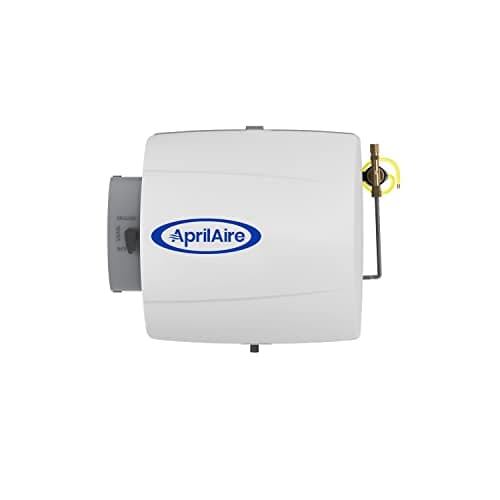 Aprilaire Model 500Top pickTwelve gallons a day against a stated 3,600 sq ft, on the same published basis as the 700. It is the bypass design, which means it borrows the furnace blower instead of bringing its own fan. | A ducted house, without the fan-powered price | 12.0published · 3,552 sq ft | |
| 2 | 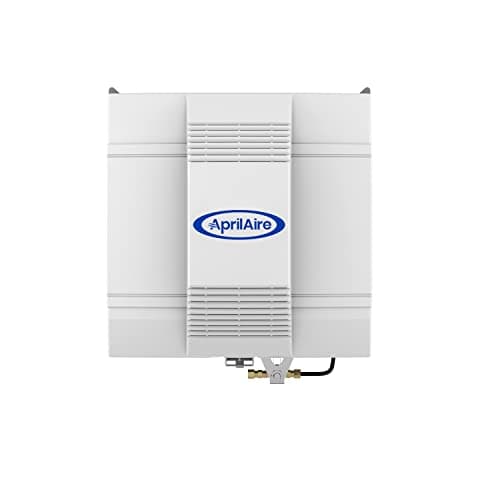 Aprilaire Model 700Eighteen gallons a day against a stated 5,300 sq ft, cited to AHRI Guideline F. It is ducted, it needs installing, and it is the only sizing claim here with a standard behind it. | An actual whole house, sized against a standard | 18.0published · 5,328 sq ft |
If you are having a whole-house humidifier installed, this is usually the only real choice in front of you, and it is often made by whoever is quoting the job rather than by you.
The two designs are more alike than the names suggest. Both mount in ductwork, both run water across a replaceable panel, both drain to waste rather than holding a reservoir - which is why neither has the standing-water problem that dominates every portable humidifier on this site. The difference is one component: whether the unit brings its own fan.
We earn a commission if you buy through the links on this page, at no extra cost to you. It does not change what we recommend or the order the picks appear in. Full disclosure. Prices checked October 13, 2026.
| # | Product | Best for | Gal/day | Price |
|---|---|---|---|---|
| 1 | Aprilaire Model 500Top pickTwelve gallons a day against a stated 3,600 sq ft, on the same published basis as the 700. It is the bypass design, which means it borrows the furnace blower instead of bringing its own fan. | A ducted house, without the fan-powered price | 12.0published · 3,552 sq ft | |
| 2 | Aprilaire Model 700Eighteen gallons a day against a stated 5,300 sq ft, cited to AHRI Guideline F. It is ducted, it needs installing, and it is the only sizing claim here with a standard behind it. | An actual whole house, sized against a standard | 18.0published · 5,328 sq ft |
The mechanical difference, in one paragraph
A bypass humidifier has no fan. It is installed with a duct - the bypass - connecting the supply plenum to the return, and the pressure difference your furnace blower creates between those two pushes air through the humidifier and across the wet panel. Aprilaire's own name for the Model 500 is its "Small Bypass Evaporative Humidifier", which tells you the whole design.
A fan-powered humidifier carries its own blower, so it does not need a bypass duct or the pressure difference. Aprilaire describes the Model 700 as fan-powered and says the fan "pulls air directly from your furnace, moisturizing the air before returning it to the air ducts to be dispersed throughout your home."
What each one publishes
Aprilaire is the only maker in our set that publishes a daily output figure and a coverage figure together, which makes this the one comparison on the site where both sides can be checked against their own numbers rather than against a room-size claim with nothing behind it.
| Model 500 (bypass) | Model 700 (fan-powered) | |
|---|---|---|
| Output | 12 gal/day | 18 gal/day |
| Coverage | Up to 3,600 sq ft | Up to 5,300 sq ft |
| Implied rate | 300.0 sq ft per gal/day | 294.4 sq ft per gal/day |
| Water panel | Model 10 | Model 35 |
| Panel interval | Annual | Annual |
| Control power | 24 VAC transformer | 24 VAC transformer |
| Own fan? | No - uses the furnace blower | Yes |
| Bypass duct needed? | Yes | No |
Look at the third row. 300.0 and 294.4 square feet per gallon per day - two different machines, two different mechanisms, and the same underlying rate to within two percent. That consistency is why this site's whole sizing method is derived from Aprilaire's published pairs rather than from a standard we could not read. The derivation is on gallons per day.
How to choose, in order
Four questions, and the first one settles most houses on its own.
- How many gallons a day does your house actually need? Floor area times ceiling height divided by 8, divided by 296. If the answer is comfortably under 12, the bypass unit covers it and the fan-powered one is capacity you are paying for and will not use.
- Is there a route for a bypass duct? A bypass needs a physical path between the supply and return plenums. In a tight mechanical closet, a crowded basement, or some horizontal furnace installs, there simply is not one - and that alone decides it.
- How does your heating actually run? Long, low-temperature cycles or infrequent firing means a bypass unit is moving air less of the time than you would assume from its output figure.
- What is the installed difference, not the sticker difference? The fan-powered unit costs more to buy, and the bypass unit adds duct work to the install. Get both quoted as fitted rather than comparing box prices.
Where steam fits
There is a third ducted category and it is worth ruling in or out early, because it answers the heat-pump problem both evaporative designs share.
A steam humidifier boils water and injects vapor into the duct, so it does not depend on supply-air temperature at all. Both the units on this page are evaporative: they rely on reasonably warm air passing over a wet panel, and they become less effective as that air gets cooler. In a house heated by a heat pump, where supply air is much cooler than a gas furnace produces, that is a real limitation on both.
The costs are electricity and price. A steam unit is the most expensive of the three to buy and by a wide margin the most expensive to run, because boiling water is expensive in a way that blowing air across a wet panel is not. We cover the mechanism trade on steam versus evaporative, and it is worth reading before committing either way.
What both designs get right
It is worth being clear about how much these two have in common, because the shared half is the part that makes either one better than a portable humidifier for a whole house.
- No reservoir. Water passes through and leaves. Nothing stands still long enough to grow the pink film or the mold that dominate portable-humidifier ownership - the subject of most of our cleaning hub.
- An annual consumable, not a monthly one. Aprilaire's maintenance page puts the water panel on Models 300, 500, 600, 700 and 720 on an annual schedule, plus an annual distribution-tray inspection. A portable wick is every 30 to 60 days. That is roughly a fourfold to sixfold difference in consumable count.
- A published, checkable size claim. Both units state capacity in gallons per day alongside coverage in square feet. Almost nothing else in this category does, which is the point of our brand comparison.
- Whole-house coverage from one machine. A 2,400 square foot house needs about 8 gallons a day and no portable humidifier we cover delivers that. Either unit here does.
What both designs cost you
The honest counterweight, and it applies equally to both.
- It is a project, not a purchase. Ductwork, a water supply, a drain, a humidistat and an outdoor sensor. Unless you are comfortable cutting into a plenum, it needs a contractor - and the installed cost is a different order of magnitude from a portable. Whole-house installation covers what the job involves.
- They waste water. The drain design that keeps them clean also sends water down it. Aprilaire's water-saving Model 400 captures excess water in a reservoir instead, and retains more mineral internally as the trade - there is no free lunch in the mechanism, only a choice about where the mineral ends up.
- They need ducted forced-air heating. No ducts, no ducted humidifier. This is not a fixable objection and it rules the category out for a lot of houses.
- You do not own the decision if you rent. Both are permanent modifications to somebody else's furnace.
The short answer
Work out your gallons per day first. Under about 12, with a sensible route for a bypass duct and a furnace that actually cycles, take the bypass unit and keep the difference. If you have already settled on bypass, Aprilaire 500 vs 600 is the capacity question that comes next. Above that figure, or with nowhere to put the duct, or with heating that runs long and cool, the fan-powered unit is not an upsell - it is the one that will do the job.
And if the arithmetic put you well under about 4 gallons a day, neither of these is your answer: that is portable territory, and whole house versus room is the page to read instead.
The picks, in full
Top pick · A ducted house, without the fan-powered price
Aprilaire Model 500
Twelve gallons a day against a stated 3,600 sq ft, on the same published basis as the 700. It is the bypass design, which means it borrows the furnace blower instead of bringing its own fan.
This is the cheaper half of the whole-house decision and, for a lot of houses, the correct half. Aprilaire calls it a small bypass evaporative humidifier, and the published pair - 12 gallons a day to 3,600 square feet - works out to 300 square feet per gallon per day, which is within two percent of the rate we derive from its whole range.
The bypass design is the reason it costs less. Instead of carrying its own fan it takes a duct between the supply and return plenums and lets the furnace blower push air across the water panel. Fewer parts, less to install, less to fail - and one real consequence, which is that it moves air only when the furnace blower is moving air.
At 12 gallons a day it covers most single-family houses. The arithmetic for what your house actually needs is on our sizing chart; if it lands above about 12 gallons a day, or your ductwork has nowhere sensible for a bypass duct to go, that is the point at which the fan-powered 700 earns its extra cost.
What works
- Publishes capacity and coverage together, which almost nothing else in the category does
- No reservoir, so none of the standing-water maintenance that dominates portable humidifiers
- Water Panel on an annual schedule rather than a wick every 30 to 60 days
- Materially cheaper than the fan-powered model, installed or not
What does not
- Humidifies only while the furnace blower runs, because it has no fan of its own
- Needs somewhere to route a bypass duct between supply and return, which not every install has
- Requires ducted forced-air heating, a water supply, a drain and realistically an installer
- Wastes water: the drain that keeps it clean also sends water down it
Skip this ifyour house needs more than about 12 gallons a day, or your ductwork has no practical route for a bypass duct. Both point at the fan-powered 700 instead.
The arithmetic
- Published output (continuous)
- 12.0 gal/day
- Covers, at 296 sq ft per gal/day
- 3,552 sq ft
- Maker’s coverage claim
- 3,600 sq ft
- Output that claim would need
- 12.2 gal/day
Output as the manufacturer publishes it. Coverage rate derived from Aprilaire’s own published capacity-and-coverage pairs.
Published specification
- Tank
- not publishedThere is no tank. It is plumbed to the water supply and drains to waste.
- Output/day
- 12 gal/daySource
- Coverage
- Up to 3,600 sq ftAprilaire states this for tightly constructed homes. It is one of the three published capacity-and-coverage pairs our 296 sq ft per gal/day rate is derived from.Source
- Power
- 24 VAC via the supplied transformerAprilaire ships a Model 60 digital automatic humidistat, an outdoor temperature sensor and a saddle valve in the box.Source
- Filter
- Model 10 Water PanelAprilaire's maintenance page puts Models 300, 500, 600, 700 and 720 on an annual schedule, plus an annual distribution-tray inspection.Source
- Cleaning
- Drains to waste, so no water stands inside the unitThe same design property as the 700: nothing sits still long enough to grow a film.Source
#ad · how this is funded · price as of October 13, 2026
Pick 2 · An actual whole house, sized against a standard
Aprilaire Model 700
Eighteen gallons a day against a stated 5,300 sq ft, cited to AHRI Guideline F. It is ducted, it needs installing, and it is the only sizing claim here with a standard behind it.
This is the reference point for the whole site. Aprilaire is the only maker in our set that publishes a capacity in gallons per day and a coverage in square feet together, and cites the residential sizing standard as the basis for pairing them. Three of its models do it consistently: 12 gal/day to 3,600 sq ft, 17 to 5,000, and 18 to 5,300. Those three pairs are where our 296 square feet per gallon per day comes from.
Everything else follows from the fact that it drains. There is no reservoir, so there is no standing water, so the pink film and the mold that dominate portable-humidifier ownership simply do not arise. The Water Panel goes once or twice a heating season instead of a wick every 30 to 60 days, which changes the recurring cost by an order of magnitude.
The honest counterweight is that this is not a purchase, it is a project. It mounts in ductwork, it needs a water line and a drain, it needs a humidistat and an outdoor sensor, and unless you are comfortable cutting into a plenum it needs a contractor. Our whole-house cost page works through the break-even against running several portables.
What works
- The only sizing claim in this set with a published standard behind it
- No reservoir, so no standing water and none of the maintenance that follows from it
- Water Panel changed once or twice a season instead of a wick every month or two
What does not
- Requires ducted forced-air heating, a water supply, a drain and, realistically, an installer
- Installed cost is a different order of magnitude from any portable here
- Wastes water: the drain design that keeps it clean also sends water to waste
Skip this ifyou rent, or you heat with anything other than a ducted forced-air system. Neither is a fixable objection.
The arithmetic
- Published output (continuous)
- 18.0 gal/day
- Covers, at 296 sq ft per gal/day
- 5,328 sq ft
- Maker’s coverage claim
- 5,300 sq ft
- Output that claim would need
- 17.9 gal/day
Output as the manufacturer publishes it. Coverage rate derived from Aprilaire’s own published capacity-and-coverage pairs.
Published specification
- Tank
- not publishedThere is no tank. It is plumbed to the water supply and drains to waste.
- Output/day
- 18 gal/daySource
- Coverage
- Up to 5,300 sq ftAprilaire states this for tightly constructed homes and cites AHRI Guideline FSource
- Power
- 24 VAC via the supplied transformerSource
- Filter
- Model 35 Water PanelAprilaire's maintenance page puts this on an annual schedule, plus an annual distribution-tray inspection. Its product page says once or twice per heating season; the two documents differ and we take the more specific one. Either way it is by far the longest interval of any unit here.Source
- Cleaning
- Built-in drain flushes mineral build-upWater does not stand inside the unit, which removes the standing-water problem entirelySource
#ad · how this is funded · price as of October 13, 2026
Questions people actually ask
What is the difference between a bypass and a fan-powered humidifier?
A bypass humidifier has no fan of its own - it is installed with a duct between the supply and return plenums and relies on the pressure difference your furnace blower creates to move air across the water panel. A fan-powered unit carries its own blower, so it needs no bypass duct and does not depend on the furnace blower running.
Is a fan-powered humidifier better than a bypass?
It is bigger and more independent, not automatically better. Aprilaire publishes 18 gallons a day for its fan-powered Model 700 against 12 for the bypass Model 500. If your house needs under 12 gallons a day and there is a route for a bypass duct, the extra capacity is money you will not use. If there is nowhere for the duct, or your furnace cycles infrequently, the fan-powered unit is the one that works.
Does a bypass humidifier work when the furnace is off?
Not meaningfully. It has no fan, so it depends on the furnace blower to move air through it. That is the practical difference between the two designs and it matters most on mild days and in houses with heat pumps, where supply air runs long, cool cycles.
Do you need a bypass duct for a fan-powered humidifier?
No. That is the main installation advantage: a fan-powered unit mounts to the plenum and supplies its own airflow, so it fits installs where there is no practical path between supply and return for a bypass duct.
What size whole-house humidifier do I need?
Size it in gallons per day rather than by model name: floor area times ceiling height divided by 8, divided by 296. A 2,400 square foot house works out to about 8.11 gallons a day and a 3,600 square foot house to about 12.16 - which lands right at the published ceiling of Aprilaire's bypass Model 500.
Is steam better than a bypass or fan-powered humidifier?
It is the only one of the three that does not depend on supply-air temperature, because it boils water rather than evaporating it off a panel - which makes it the usual answer for heat-pump houses. It is also the most expensive of the three to buy and to run. The mechanism trade is on steam versus evaporative.
Sources
Every figure on this page came from one of the documents below, read on the date shown. We do not cite other review sites, forum posts or video reviews as sources of fact.
- Aprilaire Model 500 - manufacturer spec page (retrieved September 1, 2026)
- Aprilaire Model 700 - manufacturer spec page (retrieved September 1, 2026)
- Aprilaire Model 400 - manufacturer spec page (retrieved September 1, 2026)
- Aprilaire - Humidifier Maintenance (per-model water panel schedule: annually for Models 300, 500, 600, 700 and 720, twice per heating season for the Model 400; annual distribution tray inspection; steam canister annually and electrode wires every three years)
- AHRI Guideline F - Selection, Installation and Servicing of Residential Humidifiers (the residential sizing standard; ahrinet.org returned HTTP 403 to this build, so we cite it as the governing document without paraphrasing text we did not read)
- US Environmental Protection Agency - Use and Care of Home Humidifiers (relative humidity ceiling, three-day cleaning interval, low-mineral water, microorganism warning)
Read next
Whole house
Whole house humidifiers
How ducted whole-house humidifiers work, the drainage advantage that changes their maintenance entirely, and the requirements that rule most people out.
Top pick: Aprilaire Model 700 · 18.0 gal/day
#ad · how this is funded · price as of October 13, 2026
Whole house tech
Steam vs evaporative whole house
The two whole-house humidifier technologies compared on capacity, running cost, and the furnace-dependency that decides between them.
Top pick: Aprilaire Model 700 · 18.0 gal/day
#ad · how this is funded · price as of October 13, 2026
Whole house
Whole house cost, against the portables it replaces
The ownership case for a ducted humidifier against multiple portables, with the consumable arithmetic and an honest statement of what we cannot cost.
Top pick: Aprilaire Model 700 · 18.0 gal/day
#ad · how this is funded · price as of October 13, 2026
Whole house sizing
Whole house humidifier sizing chart
Whole-house sizing by square footage, built from published manufacturer capacity-and-coverage pairs rather than copied from another chart.
Top pick: Aprilaire Model 700 · 18.0 gal/day
#ad · how this is funded · price as of October 13, 2026

Aprilaire 500 vs 600
The Aprilaire 500 and 600 are the same design at two capacities - 12 gal/day to 3,600 sq ft against 17 to 5,000. Which one your house needs, worked from your own square footage, and the consumable difference nobody mentions.
Top pick: Aprilaire Model 500 · 12.0 gal/day
#ad · how this is funded · price as of October 13, 2026
Reviewed
Aprilaire 700 review
A full review of the fan-powered Aprilaire 700: the 18 gal/day claim with AHRI Guideline F behind it, what its own fan buys over a bypass unit, why the drain removes the problem that defines portable humidifiers, and the cost nobody quotes.
Top pick: Aprilaire Model 700 · 18.0 gal/day
#ad · how this is funded · price as of October 13, 2026
Found a number that is wrong? Tell us and we will fix it and say so. How we pick shows every formula used on this page.